Zero Waste School

Zero Waste School

Creating healthier schools. Building a circular city.

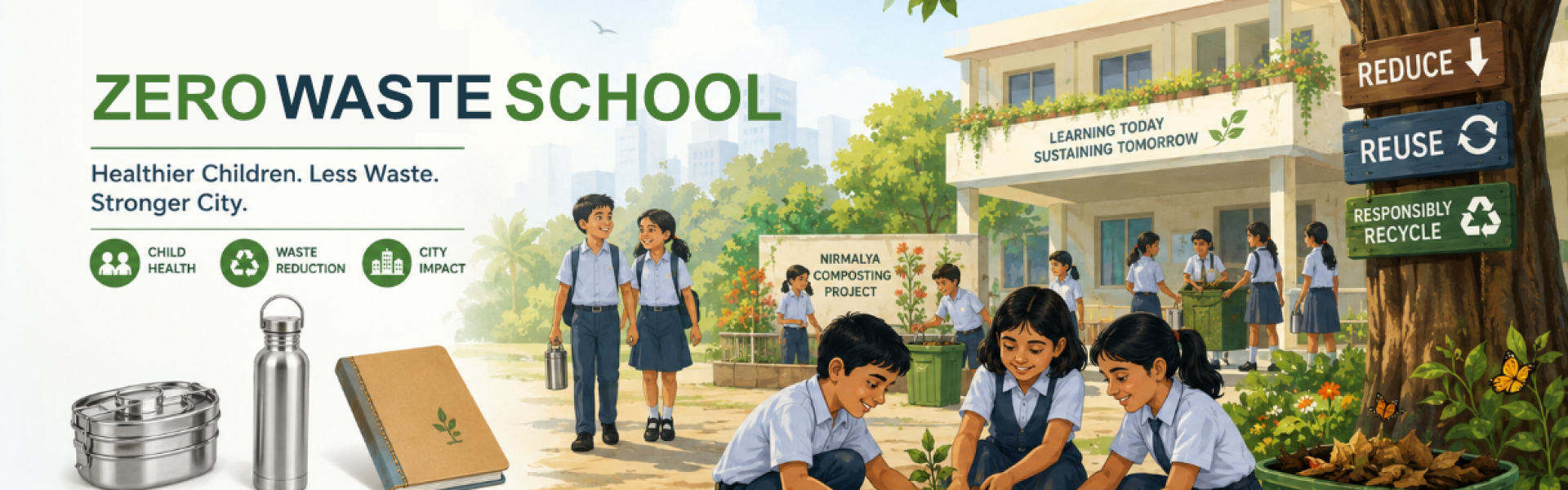
Schools as Catalysts for a Zero-Waste City

At Mission City Chakra, we believe a Zero Waste School is much more than a school that manages its own waste well. Our vision is to create healthier learning environments for children while empowering schools to become catalysts for a Zero-Waste City.

Schools are uniquely placed to influence thousands of students, families and communities. By adopting thoughtful material choices and practical circular economy projects, they can protect child health, reduce waste at its source, and inspire sustainable lifestyles beyond the school campus.

Some initiatives here focus on reducing waste generated within the school, such as replacing plastic food-contact products or managing dry leaves. Others extend into the community. Schools can host nirmalya composting projects, create butterfly gardens using dry leaves and reused buckets, or demonstrate innovative solutions that families and neighbourhoods can easily replicate.

Every initiative on this page is designed to achieve three goals—protect children’s health, reduce waste through circular design, and transform schools into living laboratories that help build a more sustainable city.

Zero Waste School

The initiatives are divided into three levels

Foundational Policies

Level 1
The highest-impact changes every institution should adopt

Circular Operations

Level 2
How the institution manages its own materials

Community Leadership

Level 3
How the institution helps make the city more circular

START HERE

LEVEL 1: Foundational Policies

Every Zero Waste School should begin here.

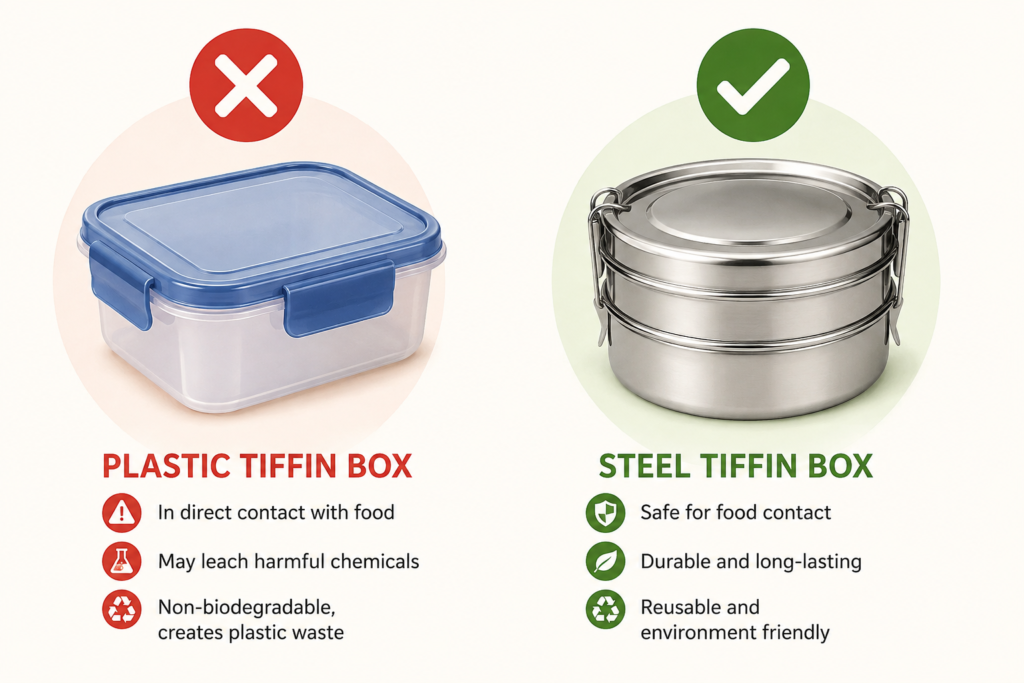
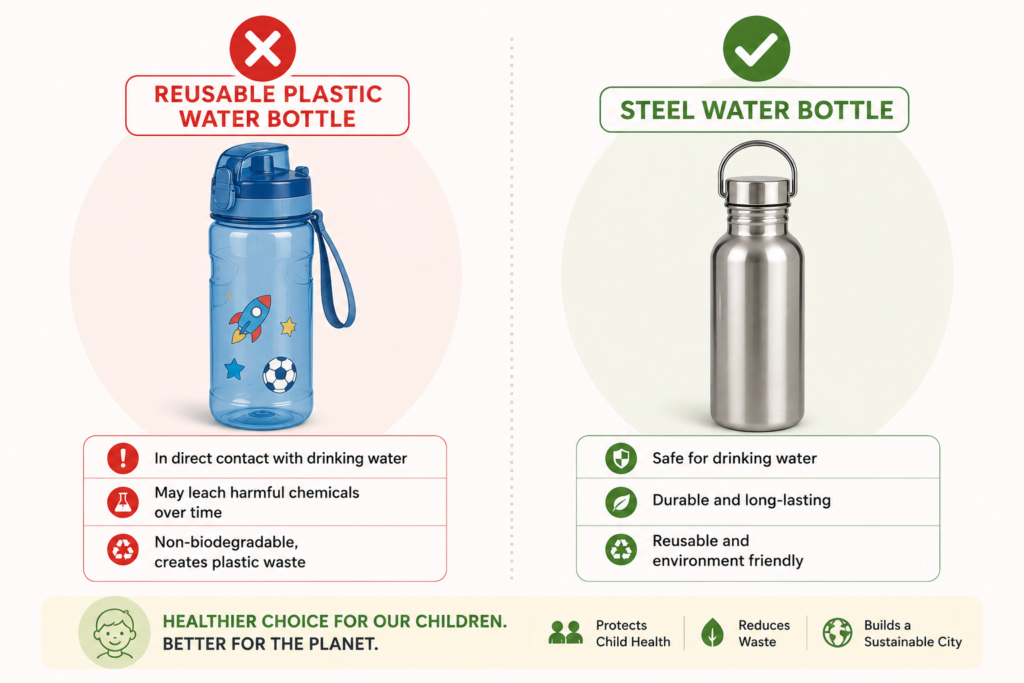
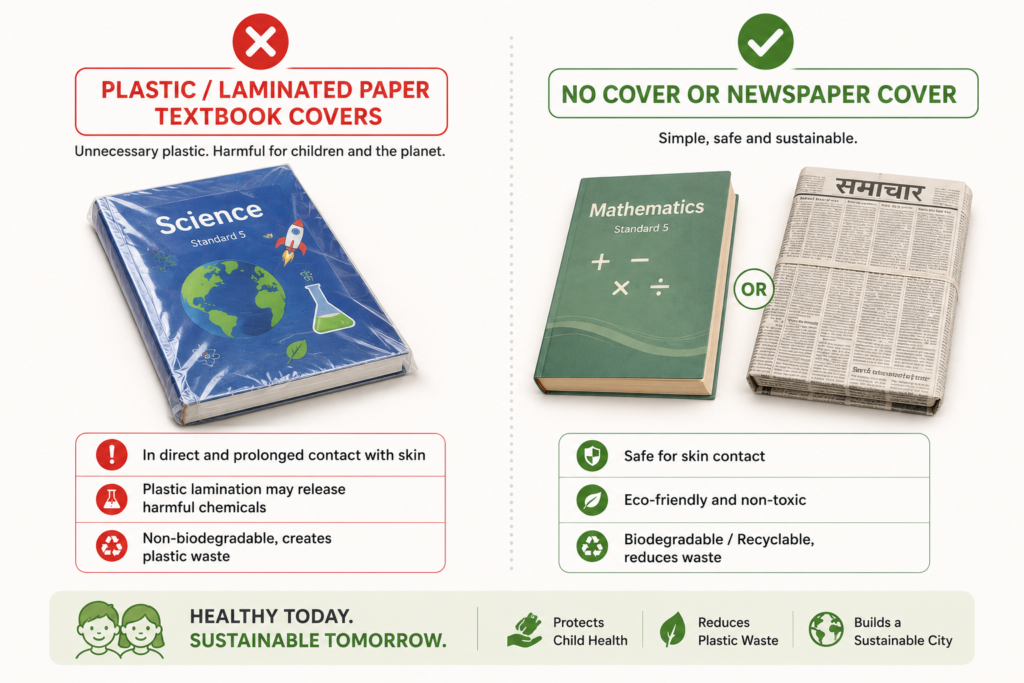
The products children carry every day should support their health while generating the least possible waste. Mission City Chakra recommends that every school adopt these three measures as institutional policy like a school uniform rather than optional suggestions.

PolicyWhy?Healthy Alternative
No Plastic Tiffin BoxesDirect food contactStainless Steel
No Plastic Water BottlesDirect drinking water contactStainless Steel
No Plastic/ Laminated Textbook CoversProlonged skin contact, unnecessary plasticNewspaper / cloth / no cover where possible

Why these three first?

These three products were selected because they satisfy all four criteria:

✅ Used daily by every child

✅ In direct contact with food, drinking water or skin

✅ Safe and practical alternatives are readily available

✅ Plastic offers no essential functional advantage in these applications

Implementing Foundational School Policies

School Principals: Powerful Agents of Change

At Mission City Chakra, we believe that school principals are among the most influential policy makers in a city. Every decision taken by a school has the potential to shape the daily habits of hundreds or even thousands of students and their families.

Our experience of working with schools across Pune has shown that simple institutional policies, when implemented thoughtfully, can lead to large-scale and long-lasting change. The role of the school is not to impose rules, but to create a healthy learning environment and help families make informed choices.

Introduce Policies with Adequate Notice

The three MCC Foundational Policies should be announced well before the beginning of the new academic year, giving parents sufficient time to prepare.

Schools can communicate the upcoming policy through:

  • Parent orientation programmes

  • Parent–teacher meetings

  • Parent WhatsApp groups

  • School circulars and newsletters

  • The school website and social media channels

Early communication helps parents understand the purpose of the policy and plan accordingly.

Communicate the Rationale

Policies are most successful when people understand why they exist.

Schools should explain that these policies are intended to:

  • Protect children’s health by reducing unnecessary contact with food-contact plastics.

  • Promote healthier and more sustainable alternatives that are already widely available.

  • Reduce plastic waste at its source.

  • Help students develop environmentally responsible habits from an early age.

Parent and student awareness sessions may be conducted wherever required. Mission City Chakra provides presentations, posters and communication material to help schools explain the scientific and environmental rationale behind these policies.

Make the Policy Part of School Systems

For lasting impact, the policy should become part of the school’s institutional processes rather than remain a one-time appeal.

Schools are encouraged to include the policy in:

  • Student induction and orientation presentations

  • Student diaries and handbooks

  • Admission forms and admission information

  • School prospectus

  • School website

  • Circulars issued at the beginning of each academic year

Embedding the policy into these systems ensures continuity, even when school leadership or staff change over time.

Encourage, Guide and Support

Mission City Chakra recommends implementing these policies through dialogue, awareness and collaboration rather than compulsion.

When parents understand the health, environmental and educational benefits, they become partners in the school’s vision rather than passive recipients of a rule.

We support schools throughout this process by providing ready-to-use communication resources, presentations, posters and implementation guidance, making it easier for every school to adopt and sustain these foundational policies.
LEVEL 2: Creating Circular Systems Within the School

Once the Foundational School Policies are in place, schools can take the next step by creating circular systems that reduce waste generated within the campus.

In nature, every resource is used again and again. Fallen leaves become compost, nutrients return to the soil, and nothing is wasted. Mission City Chakra encourages schools to adopt the same principle by viewing waste not as something to discard, but as a valuable resource.

These projects help schools reduce waste at its source, conserve natural resources, lower waste management costs and provide students with meaningful opportunities for experiential learning.

Schools can choose projects that best suit their campus, available space and resources. Some examples include:

  • Dry leaf composting

  • Butterfly gardens using dry leaves and reused containers

  • Reuse of blank pages from partially used notebooks

  • Paper collection and recycling

  • Reuse and donation of old clothes

  • Plastic-free school events and celebrations

  • Waste segregation at source

  • Water and material conservation initiatives

Each project demonstrates the principles of the circular economy while encouraging students to observe, participate and take responsibility for the resources they use every day.

Mission City Chakra provides step-by-step implementation guidance, awareness material, case studies and practical toolkits to help schools successfully adopt these circular systems.

Dry Leaf Composting

Convert dry leaves into nutrient-rich compost instead of burning or disposing of them. The project reduces waste, enriches the soil and teaches students the principles of circularity.

Benefits

🧒 Child Health

♻ Waste Reduction

🏙 Community

Difficulty: ⭐⭐⭐

Creation of a Butterfly Garden

Create a butterfly-friendly garden using dry leaf compost and planters made from reused buckets and containers. A simple project that combines waste reduction with biodiversity conservation.

Benefits

🦋 Biodiversity

♻️ Waste Reduction

📚 Experiential Learning

🏫 Circular Campus

👨‍👩‍👧 Community Participation 

Difficulty
: ⭐⭐⭐ 

Notebook Reuse Programme

Collect partially used notebooks at the end of the academic year. Duwa Foundation removes the used pages, rebinds the remaining notebooks and gives them a new life, promoting paper conservation and reuse.

Benefits

📄 Paper Conservation

♻️ Reuse

📚 Environmental Education

🌳 Reduced Resource Consumption


Difficulty: ⭐⭐

LEVEL 3: Schools as Community Resource Centres

A school’s influence extends far beyond its campus. Every school is connected to hundreds of families and the surrounding neighbourhood, making it an ideal place to demonstrate, facilitate and promote sustainable practices that benefit the entire community.

Mission City Chakra encourages schools to become Community Resource Centres for waste reduction and circular living. While some waste is generated within the school, many environmental challenges originate in homes and neighbourhoods. Schools can play a vital role in addressing these challenges by providing space, knowledge and community leadership.

For example, schools can host nirmalya composting projects even though the flowers are brought from homes. They can organise community e-waste collection drives, plastic collection campaigns, cloth collection initiatives, repair workshops, seed-sharing programmes, and sustainability exhibitions that inspire families to adopt more sustainable lifestyles.

These initiatives transform the school from a place of learning into a centre for community action. Students become active participants, parents become partners, and the school becomes a trusted institution that demonstrates practical solutions for building a healthier and more circular city.

Mission City Chakra supports schools by providing project ideas, implementation guidance, communication material and case studies, enabling every school to become a catalyst for positive change in its neighbourhood.

Nirmalya Composting

Collect nirmalya from students and the community and convert it into compost. The project prevents biodegradable waste from reaching landfills while helping schools serve the wider community.

Benefits

🌼 Organic Waste Reduction

🌱 Compost Production

🏙️ Community Engagement

📚 Experiential Learning

Difficulty: ⭐⭐⭐

Plastic Waste Collection & Recycling

While reducing plastic use remains the priority, schools can collect clean plastic waste from homes and the campus for responsible recycling through authorised partners.

Benefits

♻️ Responsible Recycling

🏫 Student Participation

🏙️ Community Engagement

🌍 Reduced Landfill Waste

Difficulty:

E-Waste Collection & Recycling

Organise periodic e-waste collection drives where students and staff bring discarded electronic items from home and school for responsible recycling through authorised recyclers.

Benefits

♻️ Responsible Recycling

🔋 Safe Disposal of Hazardous Waste

🏙️ Community Participation

📚 Environmental Awareness

Difficulty:

Punaravartan Movement – Ganesh Idol Clay Reuse

Collect clay from dissolved Ganesh idols and reuse it for seed balls, garden pots, art projects or future idols, giving the material a second life instead of discarding it.

Benefits

♻️ Material Reuse

🎨 Creative Learning

🌱 Resource Conservation

📚 Circular Economy Education

Difficulty: ⭐⭐


Freecycle Events Organisation

Organise a Freecycle Day where students exchange books, toys, games, puzzles and sports equipment they no longer use. The initiative promotes sharing, reuse and responsible consumption.

Benefits

♻️ Reuse & Sharing

📉 Reduced Consumption

🤝 Community Building

📚 Circular Economy Education


Difficulty:

Birthday Stationery Donation Drive

Celebrate birthdays by donating good-quality stationery, books, toys and school bags instead of exchanging return gifts. The donated items are distributed to students in need through Duwa Foundation.

Benefits

🎒 Reuse

🤝 Sharing & Compassion

📚 Support for Students in Need

♻️ Reduced Waste

Difficulty: