
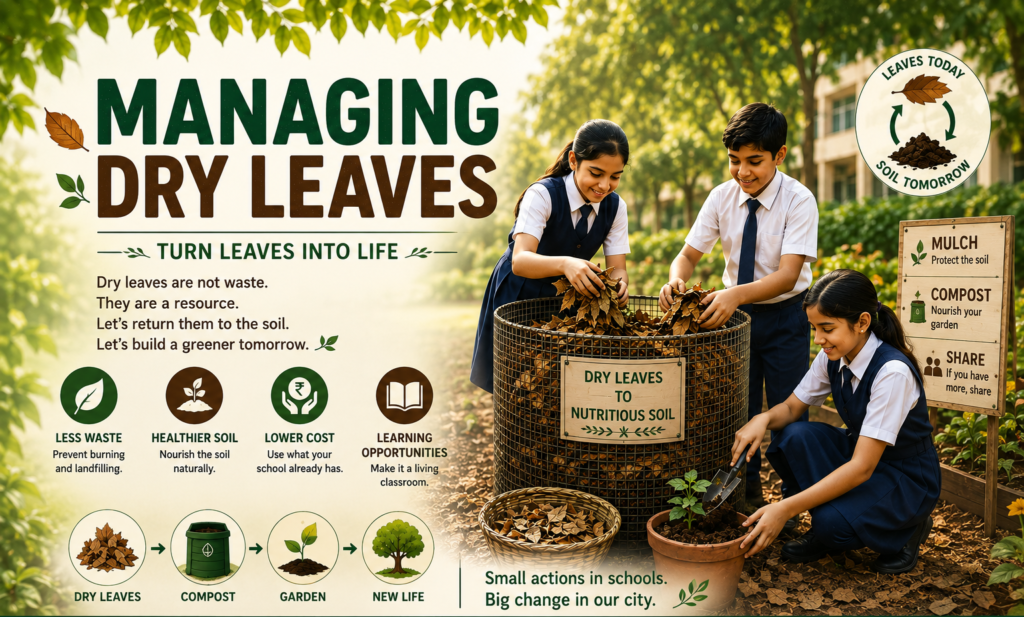
Managing Dry Leaves within the School Premises
Turn a routine school waste problem into a simple circular system.
Dry leaves are not waste. They are a resource waiting to return to the soil.
A school can manage its leaves through three simple approaches:
MULCH → COMPOST → SHARE
depending on what the campus has and what is practical.
Start With What You Already Have
Don’t begin by buying a composter. Begin by looking at your campus.
Does your school already have:
- Trees and leaf litter
- Open soil or garden beds
- An unused corner or existing pit
- Old wire mesh or other reusable material
- Water access
- A garden where compost can be used
The best dry-leaf system is one that fits the school—not one that requires the school to buy a new system.
What Can You Do With Dry Leaves?
Why Do This?
Less waste
Prevent leaves from being burnt or unnecessarily transported away.
Healthier soil
Return organic matter to the soil.
Lower cost
Use existing campus resources instead of buying complicated systems.
Experiential learning
Help students understand decomposition, soil and natural cycles.
And then a prominent line:
In a forest, fallen leaves are not waste. They are part of the next cycle of life.
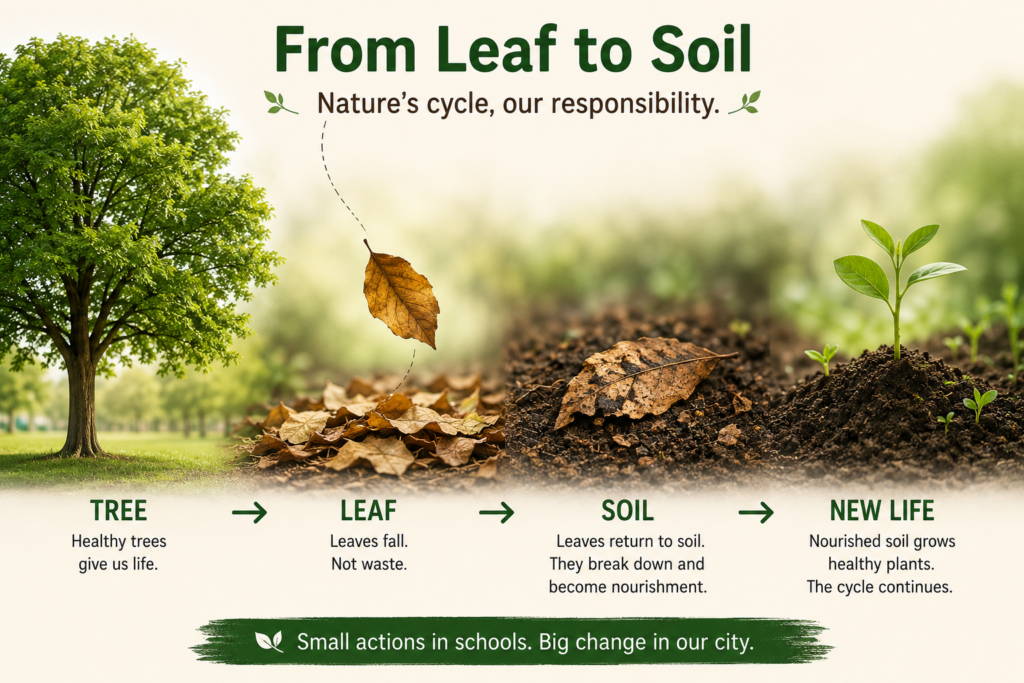
Circularity
TREE → LEAF → SOIL → PLANT → TREE
Mission City Chakra encourages schools to design systems that imitate nature—where the output of one process becomes the input for another.
How Can Your School Start?
1. Observe
Walk around the campus and understand where leaves are generated.
2. Decide
Identify which leaves can stay as mulch and which need to be collected.
3. Set up
Use an existing pit, soil area or simple enclosure—or create one using available materials.
4. Sustain
Assign responsibility, document the system and use the compost in the school garden.
Make It a Learning Opportunity
The composting system can become a living classroom.
Students can observe:
- How leaves change colour and texture
- Decomposition over time
- Moisture and rainfall
- Decomposers and soil organisms
- How finished compost changes the garden
- The journey from leaf → soil → plant
Where does a leaf go after it falls from a tree?
Make It a School System
A composting unit can be built in a day. A school system needs continuity.
The principal/school leadership approves the system.
A staff coordinator oversees it.
Housekeeping manages the routine.
Students observe and learn.
The garden uses the compost.
And importantly:
Document the process so that the system continues even when people change.
What Can You Do Next?
Continue the circular journey
🌿 Butterfly Garden
Use compost and reused containers to create a biodiversity learning space.
🌼 Nirmalya Composting
Extend the school’s composting system to biodegradable offerings from the community.
📄 Paper Reuse
Build another circular system inside the school.
Zero Waste School
Explore the complete MCC approach to school-level waste reduction.
The Handbook
Want to implement it?
Download: Managing Dry Leaves — A Practical Handbook for Schools
A practical guide covering:
- Campus assessment
- Mulching
- Composting systems
- Setting up the system
- Roles and responsibilities
- Student participation
- Troubleshooting
- Closing the loop