Protecting Child Health While Turning Policy Into Action
In just two years, Mission City Chakra — an initiative of the Centre for Sustainable Development at Gokhale Institute of Politics & Economics — has partnered with more than 600 schools across Pune. Out of these, 130 schools have already adopted zero-waste policies, impacting nearly 2.5 lakh students and their families.
The remaining schools are at various stages of implementation.
This is more than a project milestone.
It is proof of concept that large-scale waste reduction and child-health protection are not only possible — they are achievable now when we empower the right people.
The Missing Middle: Intermediate Policy Makers
Between government policies and individual behaviours lies a powerful but often invisible group:
Intermediate Policy Makers.
These include:
School principals
Office administrators
Corporate facility managers
Restaurant owners
Event managers
Housing society secretaries
They manage systems that touch hundreds or thousands of people every day.
Yet their policy-shaping power is rarely recognised.
Mission City Chakra focuses on empowering this “missing middle,” because when people closest to the problem gain authority to act, policy intent becomes real, visible, and lasting impact on the ground.
A City Drowning in Waste — Because We’re Solving the Wrong Problem
Despite decades of clean-ups and recycling projects, Pune — like most Indian cities — is overwhelmed by waste.
Why? Because we are constantly addressing symptoms, not sources.
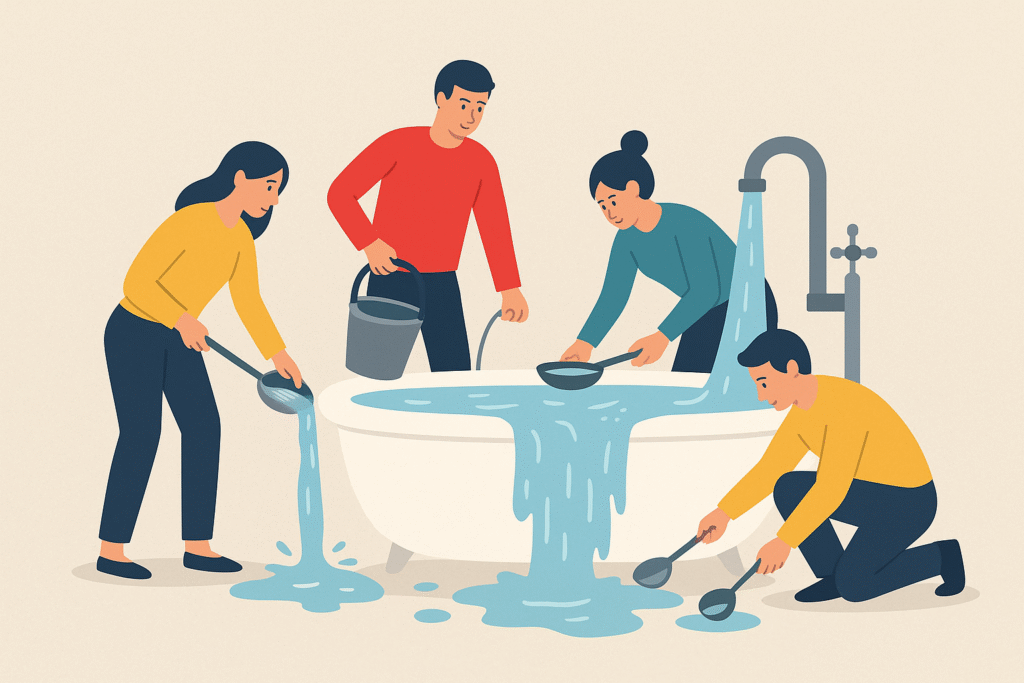
The Bathtub Analogy
A bathtub is overflowing.
You have two choices:
Bring a bucket and keep scooping out water, or
Turn off the tap.
Most waste solutions today are buckets.
Zero-waste begins by turning off the tap.
This is where Mission City Chakra directs its energy:
Preventing waste before it is created.
Refuse, Reduce — The Start of True Zero Waste
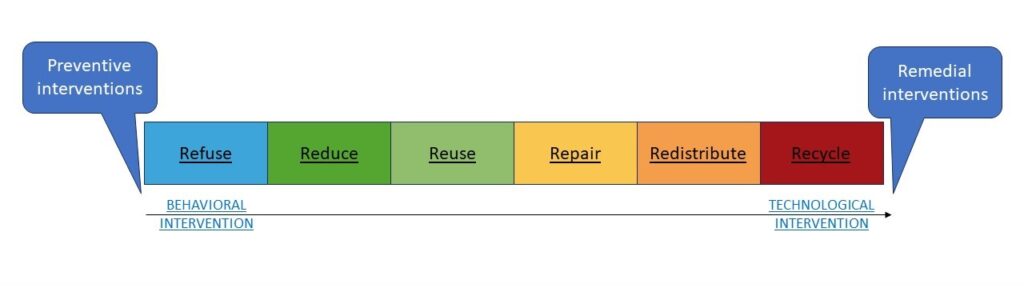
The R-hierarchy is clear:
Refuse → Reduce → Reuse → Recycle
Recycling, while useful, still:
-
consumes energy
-
emits greenhouse gases
-
manages waste after it has been created
Zero waste means shifting left — towards Refuse and Reduce, where waste generation itself is avoided.
Learning From Nature: The Original Zero-Waste System
In nature, nothing becomes waste.
A bird builds its nest from twigs, leaves, and grass.
Once abandoned, the nest decomposes and returns to the soil.
Nothing is wasted. Everything becomes part of a cycle.
Zero waste follows this exact principle:
A material is “zero waste” only if:
It biodegrades safely, or
It is infinitely recyclable without losing quality
Plastic meets neither of these conditions.
It cannot be biodegraded, and its material quality drops after each recycling cycle.
Therefore, the only sustainable strategies are:
Refuse it. Reduce it. Replace it.
Phase 1: Schools as Policy Labs for Protecting Children
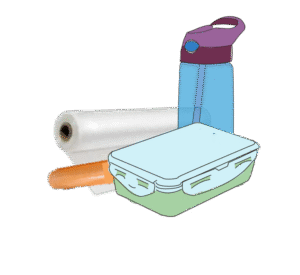
Mission City Chakra works with school principals as institutional policy entrepreneurs to implement three critical interventions:
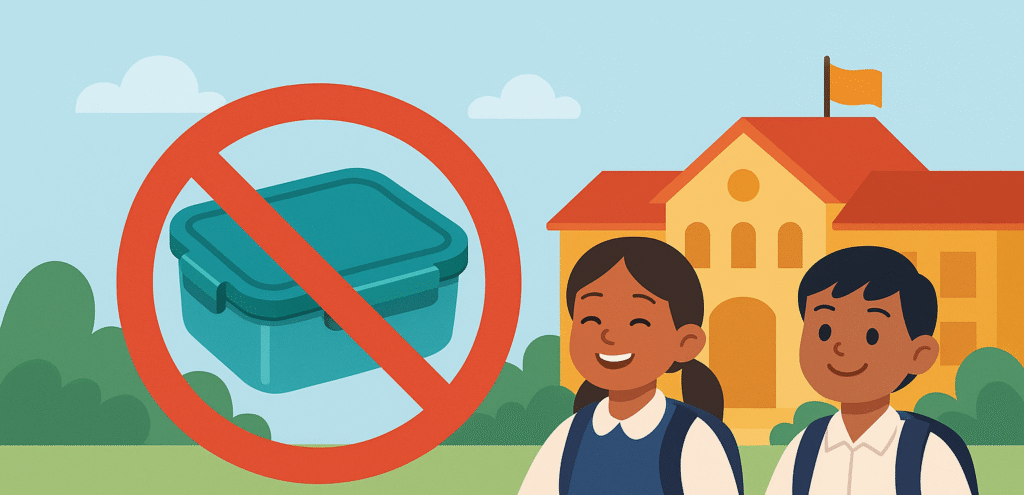
1. Ban plastic tiffin boxes → Mandate stainless-steel tiffins
2. Ban plastic water bottles → Mandate steel bottles
3. Ban plastic textbook covers → Allow no cover or simple paper
Just as schools enforce uniforms, these rules become part of standard school policy — seamlessly normalising healthier habits.
Why Start With These Three Products? (Child Health Comes First)
These items remain in daily, long-duration contact with children over many years.
1. Plastic Tiffin Boxes
Microplastics and chemical additives leach into hot food and snacks stored for hours.
Many additives are linked to:
-
Endocrine disruption
-
Hormonal imbalance
-
Early puberty
-
Learning difficulties
-
Immune interference
2. Plastic Water Bottles
Repeated use and exposure to sun/heat accelerate leaching.
Studies show microplastics in bottled water can reach hundreds of thousands of particles per litre.
3. Plastic / Laminated Book Covers
PVC and laminates contain additives associated with carcinogenic effects.
Children are uniquely vulnerable because their organs, endocrine system, and immune system are still developing.
The most powerful part?
Plastic is unnecessary here. Safe, durable alternatives already exist.
Why Stainless Steel is the Gold Standard
Virtually lifelong (often used across generations) Read the Story – माझ्या आजोबांचा डबा
Safe — no leaching, no contamination
Infinitely recyclable
Low life-cycle impact once in use
Fits perfectly into a circular economy
A child can use the same steel bottle and tiffin in school, college, and adulthood.
Principals as Health Protectors & Policy Leaders
Most principals already worry deeply about student health, yet many were unaware of the power they hold to create systemic change.
Mission City Chakra:
conducts orientation sessions
provides awareness material
guides principals in adopting zero-plastic policies
builds parent and student support
enables behavioural reinforcement through school channels
Each school becomes a mini-model for zero-waste circularity.
Scaling to 1200 Schools in Pune — And Then Across India
Pune has 1200 schools, collectively influencing over 6 lakh families — nearly 20 lakh citizens.
If every school adopts these simple zero-plastic standards:
-
Child exposure to toxins drops drastically
-
Households shift to safer materials
-
Citywide waste reduces at the source
-
Parents adopt similar practices at home
-
India moves one step closer to true circularity
This model is simple, scalable, and ready for national replication.
Call to Action: Be the Policy Maker in Your Sphere
A Zero-Waste India will not be built by government alone.
Every citizen, every principal, every administrator is a policy maker in their own ecosystem.
The first step is simple:
👉 Turn off the tap. Start with refusing unnecessary plastic.
Explore our zero-waste home checklist here:
My Zero Waste Home Guide
Aditi Deodhar
Project Lead — Mission City Chakra
Centre for Sustainable Development, Gokhale Institute of Politics & Economics
Founder — Jeevitnadi Living River Foundation
Founder — Brown Leaf Campaign