
Implementer: Nexus Westend Mall, Aundh, Pune
Owner: Mr. Pramod Naralkar
Dy General Manager: Mr. Santoshkumar Jain
The Nexus Westend Learning: At a Glance
Rather than banning ketchup, Nexus Westend Mall changed how it is offered.
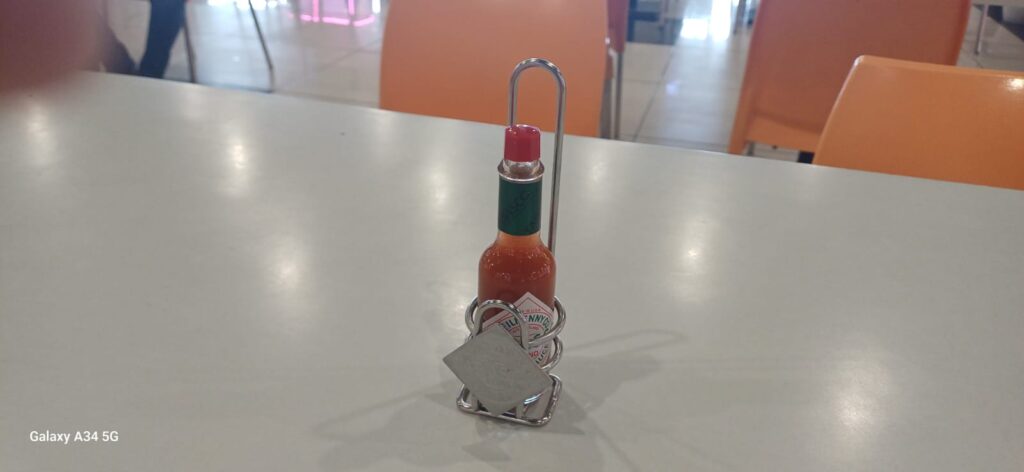
Branded glass ketchup bottles were placed on every shared dining table in attractive stainless-steel holders.
Individual food outlets continue to provide sachets when customers specifically request them, but these are no longer the default option.
This simple operational change reduces unnecessary sachet consumption while preserving customer choice.
Because operational practices are often replicated across Nexus malls, a successful intervention at one location has the potential to influence food courts across the wider network.
Problem
Food courts generate large quantities of multilayer plastic (MLP) waste through single-use ketchup sachets.
Although each sachet is small, collectively they represent a significant waste stream that is difficult to recycle.
In many food courts, sachets are the default method of serving ketchup.
Solution
Rather than banning sachets, Nexus Westend changed the way ketchup is offered.
Every dining table in the food court is provided with a branded ketchup bottle placed neatly in a stainless-steel holder.
Customers now find ketchup already available when they sit down.
If someone still prefers a sachet, it remains available, but at a small additional charge.
The preferred option is no longer the sachet. The preferred option is already on the table.
Implementation Insights
This project contains several small design decisions that together make the intervention successful.
1. Build Trust
The ketchup is provided in the manufacturer’s original glass bottle. According to Dy General Manager of the Westend Mall, Mr. Santoshkumar Jain, the bottle has a deliberately narrow neck.
Customers therefore trust that it contains the original branded product and has not been refilled.
This small detail increases acceptance.
2. Make the Sustainable Choice Convenient
The ketchup bottle is already placed on every table.
Customers do not need to:
ask for ketchup,
wait for staff,
or search for a dispensing station.
Convenience encourages the desired behaviour.
3. Change the Default
Earlier: Customer asks for ketchup sachets.
Now: Ketchup is already available.
This is a subtle but powerful behavioural intervention. People usually choose the option that requires the least effort.
4. Price the Less Sustainable Option
Since ketchup is already available free of cost on the table, sachets are no longer the default.
Customers requesting sachets are charged a nominal amount.
The project therefore discourages unnecessary sachet consumption without eliminating customer choice.
- 5. Simple Infrastructure Supports Behaviour
The stainless-steel holder:
Keeps the bottle stable, Keeps the dining table organized,
Protects the bottle,
Makes housekeeping easier.
Good design makes good behaviour easy.
Scale
The mall has not yet quantified the reduction in ketchup sachet consumption.
However, given the high daily footfall of a food court, even a modest reduction per customer could prevent thousands of multilayer plastic sachets from entering the waste stream every year.
More importantly, this operational model has the potential to be replicated across the Nexus mall network.
Key Learnings
1. Don’t remove the choice – Change the default.
2. Convenience is often more powerful than awareness.
3. Trust is essential for customer acceptance.
4. Small operational changes can create significant waste reduction.
5. Solutions become far more valuable when they are replicable across multiple locations.
Suitable For
Shopping Malls
Food Courts
IT Company Cafeterias
College Campuses
Hospitals
Airports
Railway Stations
Large Restaurants