
What Is a Thermal Paper Receipt?
Its material, life cycle, health concerns and environmental footprint
1. It is not ordinary paper
The small receipt printed at a shop, restaurant, pharmacy or ATM is often made of thermal paper.
Unlike ordinary paper, which uses ink or toner to display text, thermal paper has a special heat-sensitive chemical coating. A thermal printer applies heat to selected areas of the paper. The heat triggers a chemical reaction in the coating, making those areas dark and producing the printed text or image.
A typical thermal paper structure may contain:
Base paper: The underlying paper, generally made from virgin wood pulp, recycled fibre, or a combination.
Pre-coat: A layer that helps create a smooth, even surface.
Thermal reactive layer: Contains the colour-forming chemicals and a colour developer.
Optional protective topcoat: Helps protect the printed image and improve paper performance.
Optional backcoat: Used in some grades for specific performance requirements.
The chemical developer is particularly important. Bisphenol A (BPA) has historically been widely used. Bisphenol S (BPS) and other chemicals have also been used as alternatives. Some manufacturers now offer phenol-free thermal paper.
The term BPA-free does not necessarily mean that a receipt is free from all chemicals of concern. It tells us only that BPA is not used; the replacement chemistry matters too.
2. The life cycle of a thermal receipt
A receipt may be in a customer’s hand for only a few seconds, but its material journey begins much earlier.
1. Raw materials
The paper component comes from virgin wood pulp, recycled paper fibre, or a mixture. Chemicals used in the thermal coating are manufactured separately.
2. Paper production
The fibres are processed into paper. The paper is then prepared for the thermal coating.
3. Coating and conversion
The thermal reactive chemicals are applied in layers. Large rolls are dried, finished, slit into narrower rolls and packaged for use in billing machines.
4. Transport and distribution
The finished rolls are transported to distributors, retailers, restaurants and other businesses.
5. Printing and use
A thermal printer uses heat to produce the receipt. No ink cartridge or toner is required for the usual direct-thermal printing process. The customer receives the printed paper, and the cashier may handle it repeatedly.
6. Disposal
After use, the receipt may be discarded, landfilled, incinerated, littered or enter a paper recycling stream. What happens depends on local waste systems and the type of thermal paper.
The paper may be small, but every receipt represents the consumption of raw materials, manufacturing energy, water, chemical inputs, packaging and transport.
3. What happens when we touch a thermal receipt?
One of the less visible concerns is that some chemicals in thermal paper are present in a form that can transfer from the paper surface to our skin.
Research has demonstrated that BPA can migrate from thermal paper onto fingers and can be absorbed through the skin. A 2021 study using human skin samples found absorption of BPA and some of its alternatives under experimental conditions. The degree of absorption differed considerably between chemicals.
This is important because BPA is a known endocrine-active chemical. The endocrine system regulates hormones and several essential body functions.
The exposure pathway is straightforward:
Thermal receipt → chemical transfer to fingers and palms → contact with skin → possible absorption.
The amount of exposure depends on several factors, including the chemical used, its concentration in the paper, the duration and frequency of contact, and skin conditions.
A study observing people handling receipts in a cafeteria found that participants held receipts for an average of 11.5 minutes. Many handled them with more than their fingertips or allowed the paper to touch their palms. This illustrates why exposure assumptions based on a brief touch may not represent all real-life situations.
Cashiers, restaurant staff, retail workers and others who handle receipts throughout the day may have more frequent exposure than an occasional customer.
An important qualification: The presence of a chemical in a receipt, or its transfer to skin, does not by itself establish that a particular person will develop a health problem. Risk depends on the chemical, dose, exposure pattern and individual circumstances. However, reducing unnecessary contact is a sensible preventive measure.
4. What happens to thermal paper after disposal?
The environmental concern does not end when the customer throws away the receipt.
Thermal paper can enter several waste pathways:
Landfill: The receipt becomes part of the mixed waste stream. Chemicals in the paper may be released over time, depending on the material and landfill conditions.
Incineration: The paper is burned, creating emissions and ash that require appropriate management.
Littering: Small pieces of paper can disperse into the surrounding environment.
Recycling: Thermal paper may enter paper recycling streams if it is not identified and separated.
The recycling issue deserves particular attention. Chemicals used in thermal coatings can interfere with the quality of recovered paper and may be released during recycling and de-inking processes. A 2025 UK Health and Safety Executive report describes possible pathways through process water, wastewater treatment and sludge.
This does not mean every modern thermal receipt is automatically unrecyclable. Some newer grades are designed to be phenol-free, and recycling acceptance depends on the actual chemistry and the local recycler’s process. But customers generally cannot identify the coating chemistry by looking at a receipt.
The simplest way to avoid the material becoming waste is not to print it when it is not needed.
5. What is the carbon footprint of a receipt?
The environmental impact of a receipt is small when considered individually. The impact becomes more meaningful when multiplied by the number of transactions taking place every day.
A University of Technology Sydney study, The Life Journey of an Average Receipt, examined 708 paper receipts and used an environmental input-output model to estimate their footprint.
The study used the following average dimensions and assumptions:
Average receipt length: 24.85 cm
Average receipt width: 7.692 cm
Average paper weight: 57 grams per square metre (gsm)
Estimated weight of one receipt: approximately 1.09 grams
The study estimated that producing one metric tonne of paper receipts was associated with approximately 8.29 tonnes of carbon dioxide emissions.
Using these figures, the indicative carbon footprint of one receipt is approximately 9 grams of CO₂.
This is an estimate based on the study’s Australian data and modelling. It is not a measured footprint for every Indian receipt or every thermal paper manufacturer. Actual emissions will vary with paper specifications, manufacturing energy, raw materials, transport and disposal.
6. What could be saved if customers refuse unnecessary receipts?
Using the above estimate, we can illustrate the potential savings.
| Unnecessary receipts avoided | Paper avoided | Indicative CO₂ emissions avoided |
|---|---|---|
| 1,000 | 1.09 kg | 9 kg |
| 10,000 | 10.9 kg | 90 kg |
| 100,000 | 109 kg | 0.9 tonnes |
| 1 million | 1.09 tonnes | 9 tonnes |
These figures are illustrative estimates, not guaranteed savings. They assume that each refused receipt would otherwise have been printed and that avoiding it prevents the corresponding paper production.
The calculation does not include a separate estimate of the additional benefits from reduced chemical production, coating, packaging, transport and waste handling. Nor does it claim that every receipt avoided saves exactly the same amount of carbon.
7. A small choice at the counter can prevent waste at source
A receipt is useful when we need proof of purchase, a record for reimbursement, a warranty document or evidence for a return. We should retain it when it serves a genuine purpose.
But many receipts are printed automatically and discarded almost immediately.
When a customer does not need a printed copy, refusing it prevents the use of that paper in the first place. It also avoids the need to transport, handle and dispose of a receipt that serves no purpose.
A digital receipt may be useful when a record is required, but digital storage and delivery also have environmental impacts. The lowest-resource option is often simply not to generate a receipt when it is unnecessary.
The question at the counter is simple: Do I really need this printed copy?
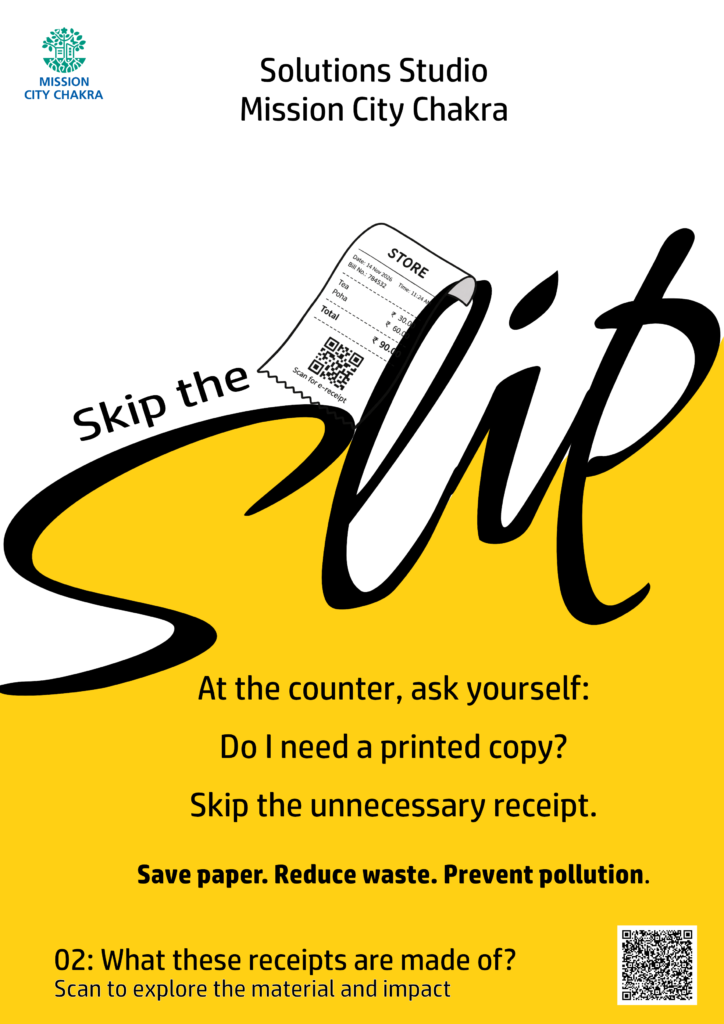
If not, skip the slip.
Skip the Slip is a small action towards preventing waste before it is created.