
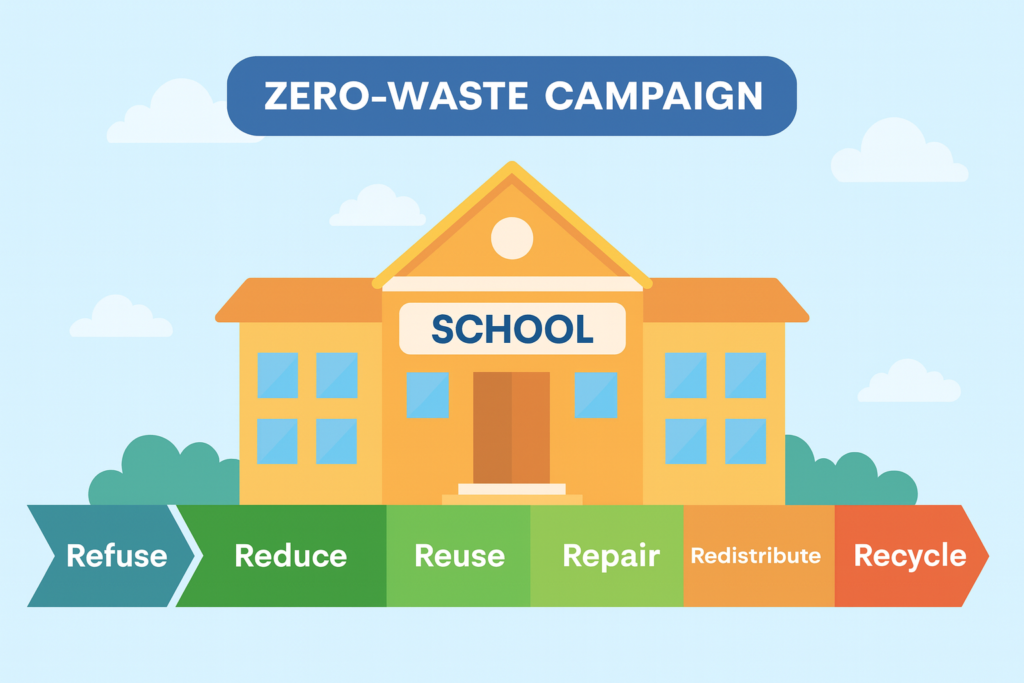
Mission City Chakra School Model offers a scalable, low-cost blueprint for Indian cities to prevent plastic waste at source through schools, families, and upstream behaviour change.
India’s Urban Challenge Needs a New Kind of Solution
India’s cities are growing faster than their waste systems.
Despite improvements in collection and processing, plastic pollution continues to rise—largely because policy and infrastructure focus on managing waste after it is created, rather than preventing it at source.
What India needs is not only better waste management, but better waste prevention.
The Mission City Chakra (MCC) model responds to this gap with a simple yet powerful idea:
Start upstream. Start with children. Scale through institutions. Change families. Prevent waste before it exists.
What Is the Mission City Chakra Model?
Mission City Chakra is a school-anchored, family-activated, behaviour-change model designed to eliminate avoidable plastic use at the point of daily contact.
The model focuses on:
prevention rather than processing
health protection alongside environmental benefit
institutional leadership rather than individual guilt
scalability without high public expenditure
At its core, MCC addresses everyday plastic exposure through small, irreversible shifts that create long-term impact.
The Core Design Principles of the MCC Model
1. Upstream Intervention
Instead of dealing with plastic after disposal, MCC eliminates plastic before it enters daily life—particularly in food and water use.
This prevents:
plastic waste generation
microplastic pollution
cumulative health exposure
Upstream interventions are globally recognised as the most cost-effective sustainability strategy.
2. Children as Catalysts, Not Targets
Children are positioned not as passive recipients of messaging, but as active agents of change.
By engaging schoolchildren, MCC:
builds lifelong habits early
creates peer-driven norm shifts
influences household behaviour organically
Each child becomes a multiplier, carrying the message home.
3. Schools as Policy Translation Spaces
Schools function as intermediate policy institutions.
Principals and teachers translate environmental intent into:
institutional norms
daily routines
family communication
This allows city-level impact without formal regulation or enforcement.
Family-Level Commitment
The Mission City Chakra Family Pledge converts awareness into action.
By asking families to commit to a time-bound shift—such as replacing plastic tiffins with steel—MCC ensures behaviour change is:
- deliberate
- measurable
- long-lasting
Health framing makes adoption faster and more equitable.
5. Proven, Culturally Familiar Alternatives
The model does not depend on new technology.
Steel tiffins, steel bottles, and non-plastic covers are:
- already culturally accepted
- cost-effective over time
- durable and recyclable
This makes MCC viable across income groups and regions.
Why the Model Works in Pune—and Beyond
Pune has demonstrated that MCC can:
- reach lakhs of students
- influence families at scale
- prevent plastic at source
- operate with minimal cost
But the real strength of the model lies in its portability.
MCC does not depend on:
- city-specific infrastructure
- complex supply chains
- heavy enforcement mechanisms
It can be adapted to:
- Tier-1, Tier-2, and Tier-3 cities
- government and private schools
- CSR-supported education programs
- state-level school systems
Health, Environment, and Economics—Aligned
Most sustainability interventions trade one benefit for another.
The MCC model aligns all three:
Health: Reduced plastic exposure in food and water
Environment: Plastic and microplastic prevention
Economics: Long-term savings through durable alternatives
This alignment is why MCC appeals to policymakers, educators, and families alike.
A Low-Cost, High-Impact Policy Complement
Mission City Chakra does not replace waste management systems.
It reduces the burden on them.
For cities investing heavily in:
collection fleets
processing plants
landfills and WtE facilities
MCC offers a complementary strategy that shrinks the waste stream itself.
This makes it especially relevant for:
municipal corporations
state education departments
CSR programs
climate action plans
Beyond Schools: Expanding the Mission City Chakra Ecosystem
Schools were a strategic starting point for Mission City Chakra—but they were never the endpoint.
Educational institutions offered the ideal first intervention space: high trust, daily repetition, and strong family linkages. Once behaviour change and material shifts were demonstrated at scale in schools, the MCC model naturally began extending to other high-impact urban systems.
Today, Mission City Chakra is actively working with:
Restaurant Owners
Restaurants are major generators of packaging waste and are critical touchpoints between producers and consumers. MCC is engaging restaurant owners to:
reduce plastic use in food preparation and delivery
shift to safer, durable, and reusable materials
normalise plastic-free food service as an industry standard
Restaurant Suppliers
Upstream suppliers often determine what materials enter kitchens before restaurant owners even have a choice. MCC works with suppliers to:
identify non-plastic and low-impact alternatives
redesign procurement norms
reduce plastic dependency embedded in supply chains
Product Designers and Manufacturers
Recognising that many plastic problems originate at the design stage, MCC is collaborating with product designers to:
re-evaluate material selection
prioritise durability, repairability, and reuse
design everyday products that are safe, long-lasting, and circular by default
This marks a shift from behaviour change alone to system-level material transformation.
Building a Framework for Sustainable Product Design
Through these engagements, Mission City Chakra is evolving into a broader framework that connects:
User behaviour (children, families, consumers)
Institutional norms (schools, restaurants, suppliers)
Product design decisions (materials, lifespan, safety)
The aim is to ensure that sustainability is not dependent solely on consumer awareness, but is embedded into the products and systems people interact with every day.
This approach recognises a simple truth:
People should not have to fight bad design to make sustainable choices.
From Pilot to National Blueprint
What began as a city-level initiative now offers a replicable national framework.
With minimal adaptation, the MCC model can support:
Swachh Bharat Mission goals
child health and nutrition objectives
plastic reduction targets
climate resilience planning
It demonstrates how soft policy instruments—norms, institutions, and commitments—can deliver hard outcomes.
The Mission City Chakra Corporate Segment: Building Zero-Waste Offices
While schools were the starting point for Mission City Chakra, workplaces represent the next critical frontier for urban waste prevention.
Corporate offices generate large volumes of avoidable, repetitive waste—from food packaging and disposables to paper, pantry waste, and procurement-related plastics. These spaces also influence daily behaviour for thousands of employees, making them powerful sites for norm-setting and systems change.
Mission City Chakra works with corporate office administrators and facilities teams to transform offices into zero-waste workplaces, using a structured, assessment-led approach.
A Systems Approach to Zero-Waste Offices
Rather than one-size-fits-all solutions, MCC treats each office as a micro-ecosystem with its own material flows, usage patterns, and operational constraints.
The office environment is mapped into five functional areas, together covering 24 clear, actionable intervention points. These areas typically include spaces such as:
entry and common areas
workstations and meeting rooms
pantry and food zones
procurement and storage
waste handling and service areas
Each area is assessed for:
material choices
usage frequency
disposability patterns
health and hygiene considerations
This allows MCC to identify where waste is being created—not just where it is being discarded.
From Assessment to Customised Zero-Waste Roadmap
The MCC corporate engagement begins with a baseline assessment of the existing situation. This includes:
identifying major waste streams
documenting plastic dependency points
reviewing current segregation and disposal practices
understanding operational and vendor constraints
Based on this assessment, MCC develops a customised zero-waste roadmap for the office.
Rather than prescribing generic solutions, the roadmap:
prioritises upstream prevention
recommends durable and safer material alternatives
sequences changes realistically
aligns with office operations and budgets
Each organisation receives targeted guidance tailored to its scale, workforce, and infrastructure.
Conclusion: India’s Cities Need Prevention, Not Just Processing
India’s plastic challenge will not be solved by infrastructure alone.
Nor will it be solved by asking individuals to constantly “choose better” within unsustainable systems.
It will be solved by changing what is designed, supplied, and normalised—starting with institutions, expanding through markets, and anchored in public health and prevention.
The Mission City Chakra model began with schools because that is where habits are formed and futures shaped. Today, it is expanding to restaurants, suppliers, and product designers—demonstrating how upstream intervention can reshape entire urban ecosystems.
This is no longer just a school initiative.
It is a scalable framework for how Indian cities can design waste out of their systems—before it exists.