
Mission City Chakra demonstrates how child-led behaviour change and family pledges can serve as a scalable upstream intervention—preventing plastic exposure, microplastic pollution, and long-term public health costs.
Why Upstream Interventions Matter in Urban Waste Policy
Urban waste systems across India—including Pune—are largely designed to manage waste after it is generated. Collection efficiency, processing capacity, and landfill diversion dominate policy conversations.
However, plastic waste—especially from everyday consumer products—poses a deeper challenge:
It enters households silently
It exposes citizens to health risks long before disposal
It fragments into microplastics that persist for decades
Upstream interventions, which prevent waste and exposure at the point of use, remain underutilised in municipal policy.
Mission City Chakra offers a replicable example of how such an intervention can be operationalised—starting with children.
The Intervention: Eliminating Plastic at the Point of Daily Contact
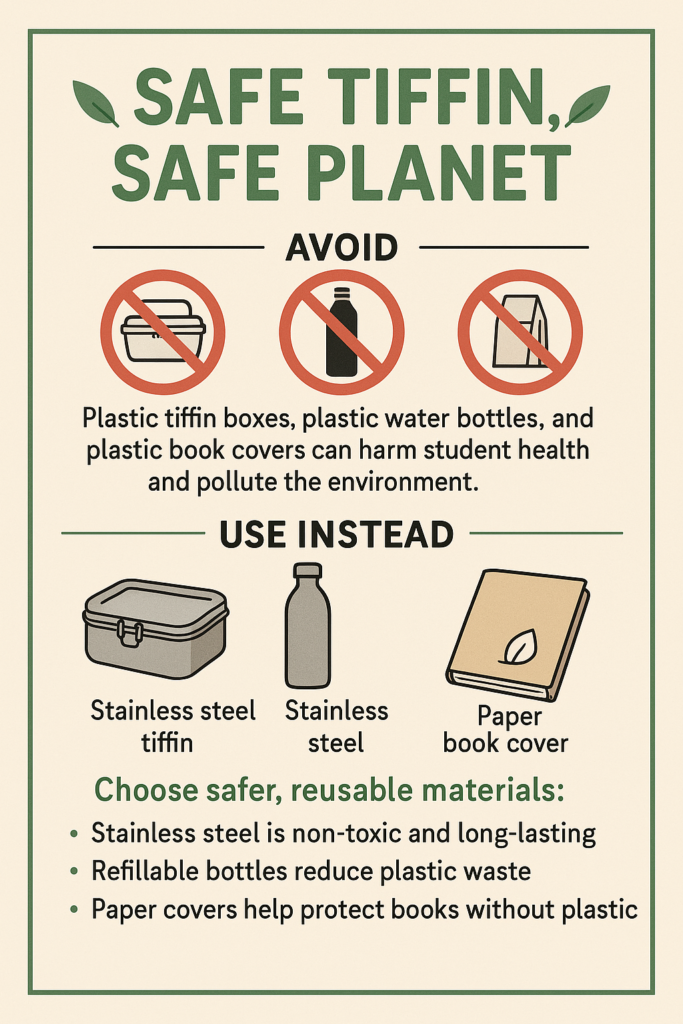
Mission City Chakra’s school-based initiative focuses on removing plastic from three high-frequency, high-exposure items:
Plastic tiffin boxes
Plastic water bottles
Plastic textbook covers
These items are used daily, come in direct contact with food and water, and are replaced frequently—making them both a health risk and a waste multiplier.
By shifting to steel tiffins, steel bottles, and non-plastic covers, the intervention addresses multiple policy objectives simultaneously:
Waste prevention
Public health protection
Resource efficiency
Behavioural change
Children as Policy Multipliers
From a policy perspective, children function as high-leverage change agents.
Evidence from behavioural science consistently shows that:
Children internalise habits faster
Children influence household consumption patterns
School-based norms spill over into families
Mission City Chakra leverages this dynamic deliberately. The intervention is not limited to awareness—it is designed to reshape household purchasing decisions through children.
This creates impact far beyond the school boundary, without regulatory enforcement or financial subsidies.
The Family Pledge: Turning Awareness into Commitment
A key policy innovation within the initiative is the Mission City Chakra Family Pledge.
Rather than encouraging vague behavioural intent, the pledge requires:
participation of both children and parents
a specific transition date
a defined action: shifting from plastic to steel tiffins
This design is critical.
Time-bound commitments increase follow-through and create durable behaviour change, which is essential for long-term policy outcomes.
Importantly, the pledge is framed as a health-protective decision, not merely an environmental one—aligning with public health priorities.
Health Protection Through Plastic Avoidance
Plastic food containers and bottles degrade over time, especially with heat and repeated use, increasing the risk of chemical migration and microplastic ingestion.
From a public health standpoint, Mission City Chakra’s approach:
reduces direct exposure pathways
lowers cumulative lifetime plastic contact
addresses health risks before clinical outcomes emerge
This makes the initiative a preventive public health intervention, not just a waste management effort.
Such prevention-first strategies are significantly more cost-effective than downstream healthcare responses.
Preventing Microplastic Pollution at Source
Plastic waste does not end at disposal. Over time, discarded plastic breaks down into microplastics that enter:
soil systems
freshwater bodies
agricultural cycles
human food chains
By preventing plastic use at the source, the initiative cuts off microplastic generation before it occurs—a benefit rarely captured in traditional waste metrics.
For cities concerned with long-term ecological and health resilience, this upstream prevention is critical.
Economic Efficiency and Resource Conservation
From a lifecycle cost perspective:
Plastic tiffins typically require replacement every 1–2 years
Steel tiffins last decades, often a lifetime
When scaled across thousands of families, the shift:
reduces material throughput
lowers manufacturing energy demand
cuts repeated consumer expenditure
decreases municipal waste handling costs
This aligns strongly with circular economy principles and demand-side resource efficiency.
Why This Model Is Policy-Relevant and Scalable
Mission City Chakra’s approach is notable because it:
does not rely on bans or penalties
requires minimal public expenditure
integrates education, health, and waste policy
scales through existing school systems
For municipal bodies, education departments, and CSR programs, this model offers a low-cost, high-impact complement to infrastructure-heavy waste investments.
From Waste Management to Waste Prevention
Most urban policies focus on managing waste flows.
Mission City Chakra demonstrates how cities can reduce waste generation itself—starting with everyday consumer choices and reinforced through social norms.
This marks a shift from:
“How do we process more waste?”
to
“How do we ensure less waste is created in the first place?”
Conclusion: A Preventive Policy Lens for Urban Sustainability
By eliminating plastic tiffins, bottles, and textbook covers through child-led and family-level action, Mission City Chakra shows that:
upstream interventions are feasible
behaviour change can be systemic
health and environmental goals can align
prevention is more effective than remediation
For policymakers seeking scalable, people-centred solutions, this initiative offers a compelling blueprint.
The future of urban waste policy may well begin—not at landfills—but in school lunchboxes.