
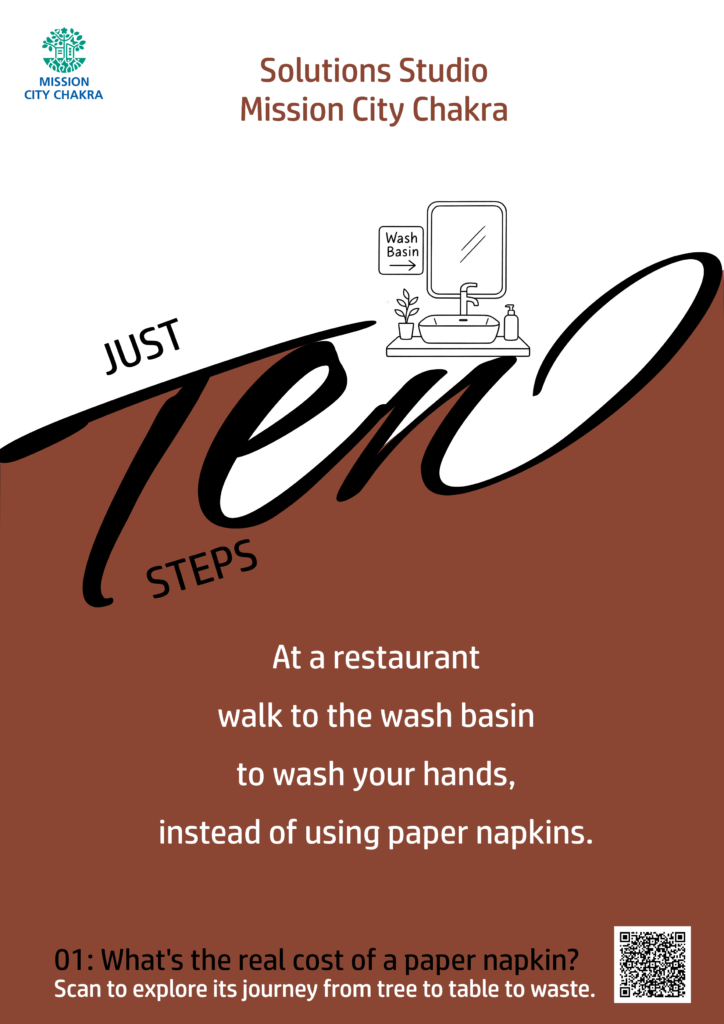
What's the real cost of a paper napkin? Explore its journey from tree to table to waste.
A paper napkin is an ordinary object. We pick one up, use it, and throw it away. It may have served its purpose in just a few minutes.
But have you ever wondered what went into making that little piece of paper?
Let’s trace its journey.
How a paper napkin is made?
A paper napkin is made from paper fibres, which may come from trees or recycled paper.
When virgin wood is used, the journey begins in a forest.
Trees are harvested and transported to a paper mill. Their bark is removed, and the wood is chipped into small pieces.
These wood chips undergo a pulping process in which cellulose fibres are separated. The pulp is cleaned, washed and, depending on the desired quality, bleached to obtain the required colour.
The pulp is then processed into thin sheets of paper. These sheets are dried, converted into soft, absorbent tissue paper, and cut and folded into napkins.
The napkins are packed, often in plastic packaging, to protect them during storage and transportation.
The packaged napkins travel through warehouses and distribution networks before reaching shops, restaurants and eventually our dining tables.
And there they wait to be used.
After a few minutes of use, the napkin is discarded.
What went into making that little napkin?
Think about the journey it has made.
Wood or recycled paper as raw material.
Water used in pulp and paper manufacturing.
Energy to operate machinery and process the paper.
Chemicals used in pulping, bleaching and other manufacturing stages.
Plastic packaging.
Fuel for transportation from the mill to warehouses, shops and restaurants.
A product that takes only a few minutes to use has travelled through an elaborate manufacturing and distribution system.

The journey shown is illustrative. Actual manufacturing processes vary depending on the type of fibre, mill technology and product specifications.
Not all paper napkins are made from virgin wood pulp, are they?
That is right. Not all napkins are made from virgin wood pulp. Some use recycled fibres or a combination of fibres.
A glance at the Life Cycle Assessment (LCA) shows that the process still consumes energy and creates pollution, even if no new trees are cut.
But paper is biodegradable, isn't it?
Yes. Paper is biodegradable. Under suitable conditions, it can decompose through the action of microorganisms.
Eventually, it can return to the natural cycle.
But does that automatically make it a sustainable choice?
Does biodegradability justify harvesting resources, using water and energy, operating machines, manufacturing packaging and transporting a product that we use for just a few minutes?
Biodegradability tells us what can happen to a material after disposal. It does not tell us whether the product needed to be used in the first place.
What does one restaurant consume in a year?
Suppose a restaurant uses 500 paper napkins everyday.
The calculation: 500 × 365 = 182,500 napkins
A restaurant uses almost 2 lakh napkins every year.
This is one restaurant in one city. Pune City alone has about 7000 restaurants.
Imagine the paper napkin consumption across all these restaurants in Pune City and India.
What about the water used at the wash basin?
That’s a fair question.
Washing hands also consumes water. So, are we simply replacing one resource-intensive activity with another?
Let’s look at the numbers.
According to WHO technical guidance, studies have reported water use of approximately 0.5–2 litres per person per handwashing session for effective hand hygiene.
Paper manufacturing also consumes water. A UK technical report on tissue production reports process-water consumption ranging from 8 to 50 cubic metres per tonne of product, depending on the manufacturing process.
For a napkin weighing approximately 1.4 grams, this works out to around 11–70 ml of process water during production.
These figures are indicative, and they cannot be directly compared as equivalent water footprints. Manufacturing water and water used at a wash basin have different uses, qualities and environmental implications.
So, does avoiding a paper napkin always save water?
Not necessarily.
But consider this: if you are already going to wash your hands, using the wash basin instead of picking up a paper napkin does not introduce an additional handwashing activity. You are simply avoiding an unnecessary disposable product.
The idea is not to wash hands unnecessarily to avoid using a napkin. It is to avoid reaching for a disposable napkin when a wash basin is the appropriate alternative.
And, as always, turn off the tap while applying soap and scrubbing your hands.
The objective is not to trade one resource for another. It is to avoid unnecessary consumption wherever we can.
Do we really need a paper napkin every time?
Think about the next time you visit a restaurant.
If you need to wash your hands, why not simply walk to the wash basin?
It is just ten steps.
A small change in our behaviour can prevent the consumption of an unnecessary disposable product.
The question isn’t whether a paper napkin can decompose after we throw it away. The question is whether we needed to use it at all.
More Reading:
1. Environmental Sustainability Assessment of Tissue Paper Production (2024)
Ana C. Dias et al., Sustainability, 16(21), 9419.
A life-cycle assessment of tissue production. Useful for explaining manufacturing stages, energy consumption, raw materials and environmental hotspots.
Read Research Paper
2. Life-Cycle Assessment of Graphic and Tissue Paper (2022)
German Environment Agency, prepared by ifeu.
Particularly useful for comparing virgin and recycled tissue paper, energy requirements, water demand, forest area and environmental impacts.
Read the Report
3. Is Paper Compostable? (2018)
NCASI – National Council for Air and Stream Improvement.
Explains the conditions required for paper biodegradation and composting, including the influence of coatings and additives.
Read Technical Brief
4. Environmental Sustainability Evaluation of Tissue Paper Production (2021)
Research published in ACS Sustainable Chemistry & Engineering.
Useful for understanding how different pulp sources and bleaching processes affect water, energy and greenhouse gas impacts.
Read Research Paper
6. Sayeed et al. (2021) – Handwashing with soap: A concern for overuse of water amidst the COVID-19 pandemic in Bangladesh
7. UK Environment Agency – The Production of Tissue: Water Consumption and Processing