
Plastic Bottle Waste: Solutions That Can Be Implemented at Scale
Plastic bottle waste is not just a collection and recycling problem. It is also an opportunity to rethink how we access drinking water, which containers we routinely use, and how institutions can reduce avoidable plastic consumption.
Individuals can make a difference by switching to reusable alternatives. However, larger and sustained change requires schools, workplaces, public institutions, businesses and local governments to make plastic reduction easier and more systematic.
Mission City Chakra documents initiatives undertaken in Pune, including projects that are active, under pilot or discontinued. These experiences offer starting points for corporators, CSR teams, funding organisations and citizens who want to implement practical solutions.
1. Solutions that reduce plastic bottle use
1. Plastic Bottle-Free Class
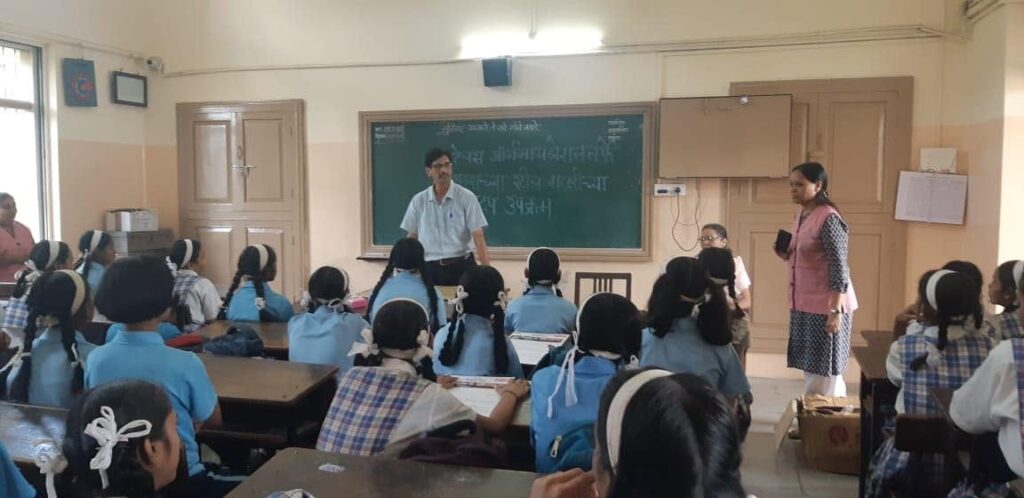
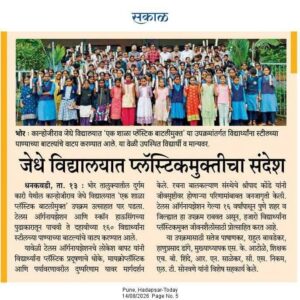
Implementer: Lokesh Bapat
Founder, Tellus Foundation
Tellus was established in 2001. The word “Tellus” is the Latin word for Earth. Since its inception, the organization has undertaken various initiatives related to environmental conservation and sustainable living.
Since 2012, Tellus has been working with schools to make one classroom at a time plastic-bottle-free.
The intervention consists of two steps:
Step 1: Awareness Generation
Lokesh Bapat conducts interactive sessions with students on:
- Plastic pollution
- Health impacts of plastics
- Microplastics
- Sustainable alternatives
The topic is communicated through stories and discussions, making a complex issue accessible and engaging for children.
Step 2: Immediate Action
At the end of the session, every student in the selected classroom receives a steel water bottle.
The objective is simple:
Replace plastic water bottles with reusable steel bottles.
Key Innovation
Many awareness programs create temporary enthusiasm but fail to result in long-term behaviour change.
To address this challenge, Tellus introduced a simple reinforcement mechanism in collaboration with the school administration.
During attendance, students are encouraged to raise their steel bottle while responding to their name. Students without the steel bottle are immediately noticed.
This is not intended as punishment. Rather, it serves as a daily reminder that caring for one’s health and the environment is a habit that requires consistency.
This simple behavioural nudge helps ensure that the bottle remains in regular use.
Scale
Since 2012, Tellus has distributed approximately 5,000 steel bottles to school students through this initiative.
The organization has also encouraged some restaurants and establishments to shift from plastic bottles to reusable glass bottles.
Tellus Strategy
Awareness → Immediate Action → Reinforcement
Tellus combines three elements:
- Awareness generation
- Provision of a practical alternative
- Reinforcement through existing school systems
The approach recognizes that awareness alone is often insufficient. Lasting behaviour change requires both an alternative and a mechanism that supports continued adoption.
What it involves
The Tellus Foundation conducts awareness sessions and provides steel bottles to students in a selected class. The intervention introduces students to the issue of plastic bottle waste while demonstrating a practical alternative.
Who can take it to scale with Tellus?
CSR teams, corporators, charitable foundations, and individual donors can work with Mr. Lokesh Bapat, Tellus Organization, implementing his already established and successful methodology in more schools through funding support/ provision of steel bottles.
2. Steel Bottles for Rickshaw Drivers
What it involves
Rickshaw drivers spend long hours on the road, often working for 10–12 hours a day.
To stay hydrated, most drivers carry drinking water with them. Traditionally, many drivers used plastic water bottles or reused single-use packaged drinking water bottles.
These bottles are exposed to heat and sunlight for long periods, raising concerns about chemical leaching and microplastic contamination.
In recent years, an increasing number of rickshaw drivers in Pune have started carrying steel water bottles instead of plastic ones.
This shift was noticed during interactions with drivers across different parts of the city.
When asked about the reason for the change, drivers shared interesting stories.
One driver explained that his daughter-in-law had advised him that plastic bottles were not good for health and gifted him a steel bottle.
Another driver mentioned reading newspaper articles about microplastics mixing with drinking water and decided to switch to steel bottles after learning about the issue.
These conversations suggest that awareness about plastic-related health concerns is gradually reaching ordinary citizens.
Who can implement it?
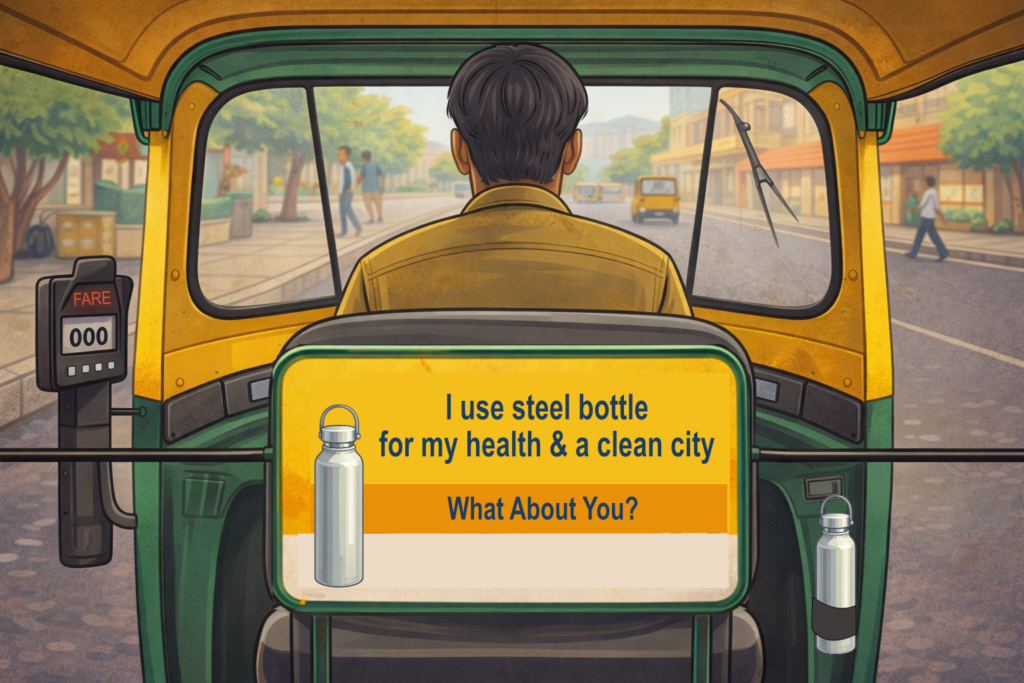
Corporators, citizen groups, CSR programmes, funding organizations and local associations can work with rickshaw unions by gifting a steel bottle to the selected number of rickshaw drivers and installing an awareness poster at the back of the rickshaw driver’s seat.
This project offers an opportunity to engage an occupational community that spends much of its working day on the road while generating awareness for the passengers without any extra effort.
The steel bottle and the awareness poster provide an opportunity for branding to convey the work to the larger public.
With a certain number of beneficiaries, the dashboard, record-keeping, the impact, and the impact showcase are easy and effective.
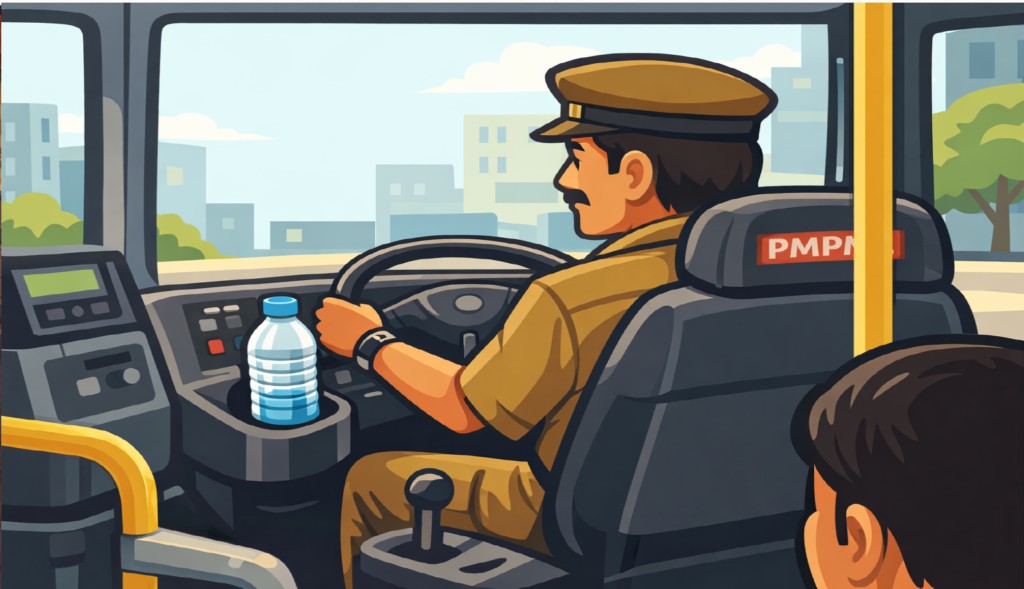
2A. Steel Bottles for PMPML Drivers and Conductors
3. Gift a Steel Bottle
What it involves
This is an individual-led intervention in which a person gifts a steel bottle to encourage a switch away from plastic. The initiative documented by Mission City Chakra demonstrates how citizens can take direct action without waiting for a large institutional programme.
Who can implement it?
Any citizen can participate. Resident associations, community groups and businesses could also adopt the idea for employee welcome kits, community events or targeted outreach. To maximise impact, recipients should be encouraged to use the bottles regularly, and the initiative should avoid creating unnecessary consumption through indiscriminate gifting.
4. School Steel Bottle Policy Programme
What it involves
Instead of relying solely on awareness campaigns, a school can make reusable bottles part of its everyday institutional practice. A steel bottle policy can be incorporated into school guidelines, supported by communication with parents and appropriate arrangements for safe drinking water.
Who can implement it?
Corporators and ward officers can facilitate adoption among schools in their areas. CSR teams and foundations can support the initial planning, communication and implementation. School management and principals are central to the process because they can institutionalise the practice and sustain it beyond a funded campaign.
The emphasis should be on policy adoption and continued implementation, not merely on distributing bottles.
5. School Awareness and Steel Bottle Programme
What it involves
This combines education about plastic bottle waste with practical support for adopting reusable bottles. Awareness helps students understand why the change matters, while a demonstration or supported transition makes the alternative tangible.
Who can implement it?
CSR teams and funding organisations can support a defined group of schools, while corporators can help coordinate participation across a ward. The programme should include teachers and parents, and establish a baseline to assess how many students routinely use plastic bottles. Follow-up checks can establish whether the intervention has led to sustained changes.
6. Bottle Refill Stations at Malls
What it involves
Convenient refill stations can reduce the need for people to purchase packaged drinking water when they visit malls and other public-facing establishments. The intervention is most effective when stations are easy to locate, accessible, hygienically maintained and supplied with safe drinking water.
Who can implement it?
Mall management, corporate property owners and CSR teams can support a pilot. Corporators or local representatives can facilitate discussions with commercial establishments in their constituencies. The project should include responsibility for water quality, cleaning, maintenance, signage and usage monitoring. Measuring refills and estimating the number of disposable bottles avoided will help assess the results.
7. Steel Bottle Ambassador Programme
What it involves
An ambassador programme recruits and supports people who can demonstrate and encourage the regular use of reusable bottles. Ambassadors could include students, teachers, employees, community volunteers or public figures who influence everyday behaviour.
Who can implement it?
CSR teams, corporators, educational institutions and citizen organisations can develop a local programme. Ambassadors can lead demonstrations, share practical experiences and encourage schools, offices and community groups to adopt reusable-bottle practices. The programme should link advocacy with specific opportunities for change, such as refill access or institutional bottle policies, rather than relying only on publicity.
2. Solutions that manage plastic bottles after use
8. Plastic Bottle Collection Points
What it involves
Dedicated collection containers can make it easier for people to deposit used plastic bottles instead of discarding them in mixed waste or public spaces. A bottle-shaped collection structure can also make the purpose immediately recognisable.
However, installing a collection container is only the first step. A successful initiative needs a reliable collection schedule, an identified operator and a confirmed destination for the bottles.
Who can implement it?
Corporators, citizen groups, resident associations, CSR teams and commercial establishments can establish collection points. Before installation, the implementing organisation should identify the collection partner, verify the recycling route, assign responsibility for maintenance and track the quantity collected and its final destination.
Collection points should complement waste prevention rather than encourage the assumption that every discarded bottle will necessarily be recycled.
9. Reverse Vending Machines for Plastic Bottles
What it involves
A reverse vending machine accepts used bottles and may provide a reward or incentive in return. Such machines can make collection visible and convenient, particularly at high-footfall locations such as railway stations, bus terminals and commercial establishments.
Mission City Chakra records a plastic bottle reverse vending machine initiative as discontinued. This is an important reminder that installing technology does not guarantee sustained results. Footfall, maintenance, collection logistics, user participation, operating costs and the downstream recycling arrangement all need to be considered.
Who can take this forward?
CSR teams, transport authorities, railway or bus operators and funding organisations could explore a new pilot, but should first examine why previous implementations stopped operating. A proposal should include an operating partner, maintenance commitments, a reliable recycling destination and measurable performance indicators. A simpler collection system may be more suitable where the costs and maintenance requirements of a machine cannot be justified.
3. Broader initiatives that can reduce plastic bottle waste
10. Mission City Chakra School Programme
What it involves
The Mission City Chakra school programme promotes institutional changes that prevent waste at source. Its wider approach can support plastic bottle reduction by helping schools move from one-off awareness activities to clear policies and practices.
Who can implement it?
School principals and management teams can adopt the relevant practices. Corporators and ward officers can facilitate participation across schools, while CSR teams and foundations can support implementation, training and monitoring. The objective is to embed waste prevention in routine school operations and measure whether the practice continues over time.
11. Plastic Collection Ecosystem
What it involves
Plastic collection and recycling require coordination among waste generators, collection agencies, aggregators, recyclers and other relevant actors. A functioning ecosystem ensures that collected bottles are segregated, transported and sent to an appropriate processing facility.
Who can implement it?
Municipal authorities, corporators, CSR programmes, waste-management organisations and recycling partners can collaborate to strengthen collection routes. A project can map existing collectors and recyclers, identify gaps in collection coverage, establish responsibilities and track material flows. This is particularly relevant where plastic bottles are generated in large quantities at markets, commercial areas, events or institutions.
Such an ecosystem is necessary for managing residual waste, but it should operate alongside measures that prevent avoidable bottle consumption.
4. How corporators, CSR teams and funding organisations can take action
For corporators and ward officers
A local representative can select a defined group of schools, public institutions or commercial establishments and facilitate a plastic bottle reduction programme. The work could begin with a baseline assessment, followed by a school bottle policy, refill access or a collection pilot for bottles that remain in circulation.
The role is to bring institutions together, resolve practical barriers and create a model that can be replicated across the ward. Results should include measurable reduction in disposable bottle use, not just the number of activities conducted.
For CSR teams
A CSR programme can support a structured pilot with defined objectives, a clear implementation partner and an evaluation plan. Options include a school steel bottle policy, an awareness and adoption programme, refill stations at commercial properties or a collection and recycling system.
Funding should cover the elements required for sustained implementation: planning, stakeholder engagement, infrastructure where needed, maintenance, monitoring and documentation. A successful pilot should produce a replicable model with transparent costs and measured outcomes.
For funding organisations and philanthropic foundations
Funding organisations can support initiatives that test practical approaches, build evidence and make replication easier. This may include evaluating the effectiveness of school policies, assessing refill station usage, testing community-level collection arrangements or comparing the costs and outcomes of different interventions.
Funding can also support documentation and dissemination so that corporators, institutions and other organisations can adopt approaches that have demonstrated results. The focus should be on building lasting systems rather than financing isolated activities.
For schools, offices and other institutions
Institutions can begin by examining where and why packaged water bottles are routinely used. They can improve access to safe drinking water, encourage reusable bottles, review procurement practices and establish appropriate policies for meetings and events.
Where disposable bottles remain necessary, the institution should ensure that they enter a reliable collection and recycling route. The approach should be practical, inclusive and sensitive to the availability of safe refill water.
5. From individual action to institutional change
Individuals can begin immediately by using a suitable reusable bottle where safe refill water is available. But the scale of the problem calls for more than individual choices.
Schools can establish policies. Offices can change procurement practices. Malls can provide refill facilities. Corporators can coordinate local implementation. CSR teams and funding organisations can support pilots, measure outcomes and help successful models spread.
The most useful question is not simply, How do we collect more plastic bottles? It is also, How can we reduce the number of bottles that need to be collected in the first place?
Ready-to-Implement Roadmaps from Mission City Chakra
Mission City Chakra develops project roadmaps for corporators, ward officers, CSR teams and funding organisations. These roadmaps translate existing initiatives into practical implementation plans, including the problem addressed, implementation steps, impact calculations and communication of results.
If your organisation would like to reduce plastic bottle waste in a school, ward, workplace or public space, contact Mission City Chakra to discuss a suitable pilot.
Let us move from managing plastic bottle waste to preventing avoidable plastic use.
Contact: missioncitychakra@gmail.com