
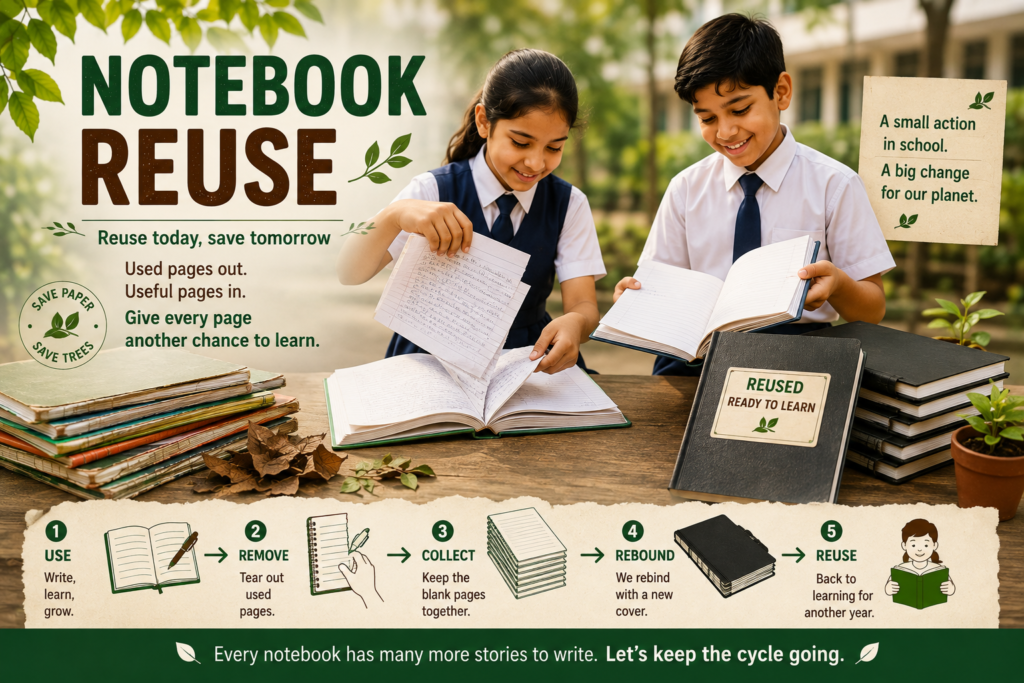
Notebook Reuse
Explore Duwa Foundation's notebook reuse initiative, where schools reuse blank notebook pages by removing only used pages and rebinding the remaining pages. Includes Kalamadi School's Pune example and guidance for schools to replicate the idea.
Give the blank pages of used notebooks another year of learning.
Every year, school notebooks are discarded even though many pages inside them are still blank.
Can we use the paper we already have before asking for more?
Duwa Foundation’s notebook reuse initiative offers a simple answer: remove only the used pages, retain the blank pages, and rebind the notebook for reuse.
The Idea
Instead of cutting out and collecting individual blank pages, students are asked to:
Tear out only the pages they have used.
The remaining blank pages stay together as a notebook.
Duwa Foundation collects these partially used notebooks and rebinds them with new black covers, giving the unused pages another life.
The approach also avoids the wastage that can happen when individual blank pages are cut out, because notebooks have different page sizes and uneven cutting can damage otherwise usable paper.
Why This Matters
📄 Save paper
The blank pages in a notebook are already a usable resource. Reusing them avoids the need to manufacture new paper for the same purpose.
♻️ Extend the life of a product
Instead of treating a partially used notebook as waste, the useful part is retained and given another life.
🌱 Make circularity visible
Students can see a simple circular process in action:
Use → Reuse → Rebind → Use again
🎓 Build a habit
The project gives students a tangible way to understand paper conservation and responsible consumption.
How Can a School Participate?
1. At the end of the academic year
Ask students to bring back notebooks that still contain unused pages.
2. Remove only the used pages
Students should tear out the pages they have written on.
Do not cut out the blank pages.
The remaining blank pages should be kept intact.
3. Collect the notebooks
The school collects the partially used notebooks and sends them to Duwa Foundation’s collection centre.
4. Rebinding
Duwa Foundation rebinds the remaining blank pages with black covers, creating notebooks that can be used again.
Please note: Duwa Foundation currently does not provide pickup. Schools need to arrange delivery to the collection centre.
An Important Learning from the Project
Earlier, students were asked to cut out and donate only the blank pages.
It sounded logical—but in practice, it created considerable wastage.
Different notebooks have different page sizes, and uneven cutting could damage or waste otherwise usable paper.
The revised approach is much simpler:
Don’t cut the blank pages.
Just remove the used ones.
This is a nice example of an important MCC principle:
Sometimes the best circular solution is the one that creates the least additional work and the least additional waste.
A Pune School in Practice
Dr. Shamrao Kalamadi High School
A local example of notebook reuse
Kalamadi School in Pune implemented the notebook reuse initiative last year.
The school collected notebooks from students and participated in the reuse process, giving students an opportunity to experience paper conservation not as an abstract environmental message, but as a simple action at the end of the school year.
Could Your School Do This?
For Pune Schools
If your school is in Pune and would like to explore this initiative, you can contact:
Duwa Kendra Foundation
Contact: 8788820338 / 8788059142
www.duwafoundation.org
For Schools Outside Pune
The idea can be replicated locally.
A school could explore partnerships with:
- local bookbinders
- paper-reuse organisations
- community groups
- NGOs
- parent groups
- local recyclers with reuse capabilities
The important idea is not the black cover or the particular binding method.
The idea is:
Keep usable pages in use for as long as possible.
Start a Notebook Reuse Programme in Your School
If your school cannot find a partner immediately, you can still begin by changing the habit:
At the end of the year, don’t throw away a notebook just because some pages have been used.
Ask:
How many blank pages are still inside?
That simple question can be the beginning of a school-wide paper conservation initiative.
Mission City Chakra
From waste collection to resource conservation
Mission City Chakra’s school programme focuses first on reducing waste at source and building circular systems within schools.
Notebook reuse is a simple example of this approach:
Don’t recycle the paper first.
Don’t throw the notebook away first.
Reuse what is already usable.
The objective is to help schools become places where students experience circularity in everyday decisions.