
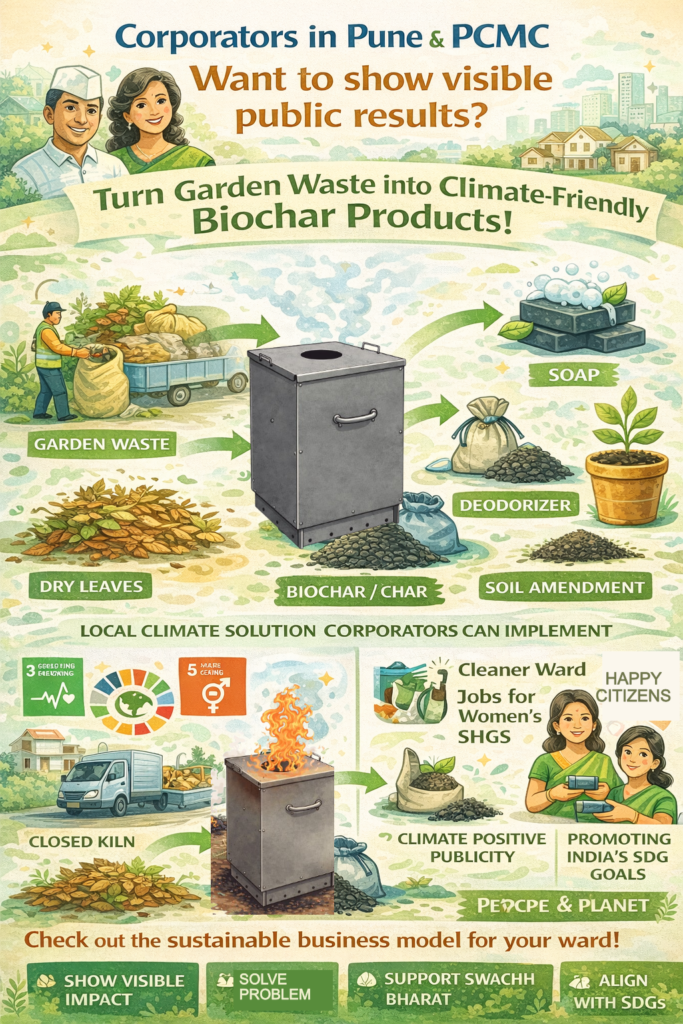
'Not a single leaf is burnt in my ward'; what a powerful announcement that would be. Yes, corporators in Pune and PCMC can stop leaf burning, create jobs for SHGs, and improve air quality by converting garden waste into biochar and biochar-based products. Learn how this model delivers visible results for citizens, the city, and party leadership while supporting Swachh Bharat, LiFE Mission, and SDGs.
1️⃣ What problem does this solve for your voters — and why it matters to corporators
Every ward in Pune and PCMC faces the same seasonal complaints:
dry leaves and garden waste dumped on roadsides
open burning of leaves by contract workers or societies
smoke near schools, temples, parks, and residential areas
increased asthma, coughing and irritation during winter
bad smell, dust, and dirty public spaces
Citizens repeatedly tell corporators:
“आजूबाजूला पालापाचोळा जाळतात , आम्हाला धुराचा त्रास होतो. .”
Open burning of leaves leads to:
PM2.5 and PM10 pollution
choking smog during mornings and evenings
irritation among elderly and children
complaints on WhatsApp groups and social media
negative perception of municipal performance
At the same time:
societies don’t know what to do with leaves
gardeners want quick disposal
contractors prefer burning because it is easy
So the corporator has:
blame from citizens
no simple visible solution
pressure from party leadership to show action
This is where the biochar model helps
Instead of sending carbon in the atmosphere through open burning:
Collect dry leaves → Convert to biochar → Make products → Create livelihoods -> Capture Carbon
This single model delivers:
cleaner ward
less smoke
less air pollution
visible green work
income for SHGs
positive publicity
And most importantly:
Citizens actually see the change — no smoke, cleaner roads, and a local climate solution.
This is exactly the type of initiative voters remember at election time.
5️⃣ What is the Impact?
How this directly benefits the corporator
This idea is not just environmentally sound.
It is politically intelligent.
✔ Visible results in your ward (vote bank impact)
Citizens see:
less leaf burning
cleaner roads and societies
green products made locally
SHG women earning through dignified work
Voters notice:
“Our corporator actually did something practical.”
This strengthens:
trust
re-election prospects
positive word-of-mouth
social media support
✔ Strong impression on party leadership
Party observers and leadership see:
innovation in waste and climate action
SHG empowerment
measurable results and data
media-coverable pilot project
scalable model for entire city
This positions the corporator as:
performer
innovator
policy-forward leader
✔ Alignment with national missions
This program directly supports:
Swachh Bharat Mission
LiFE Mission – Lifestyle for Environment
Smart Cities Mission
Atmanirbhar Bharat entrepreneurship
Women SHG livelihood schemes
✔ Maps directly to multiple SDGs
This initiative supports:
SDG 3 – Good Health and Well-being
SDG 5 – Gender Equality (SHGs)
SDG 8 – Decent Work & Economic Growth
SDG 11 – Sustainable Cities & Communities
SDG 12 – Responsible Consumption & Production
SDG 13 – Climate Action
SDG 15 – Life on Land
Perfect for reports and presentations.
Final message to corporators
This is not just a waste project.
It is:
a climate solution
a livelihood model
a visible public service
a showcase initiative for leadership
a scalable city-level program
All starting from something as ordinary as dry leaves.
Convert leaves into livelihoods.
Convert smoke into soil.
Convert complaints into appreciation.