
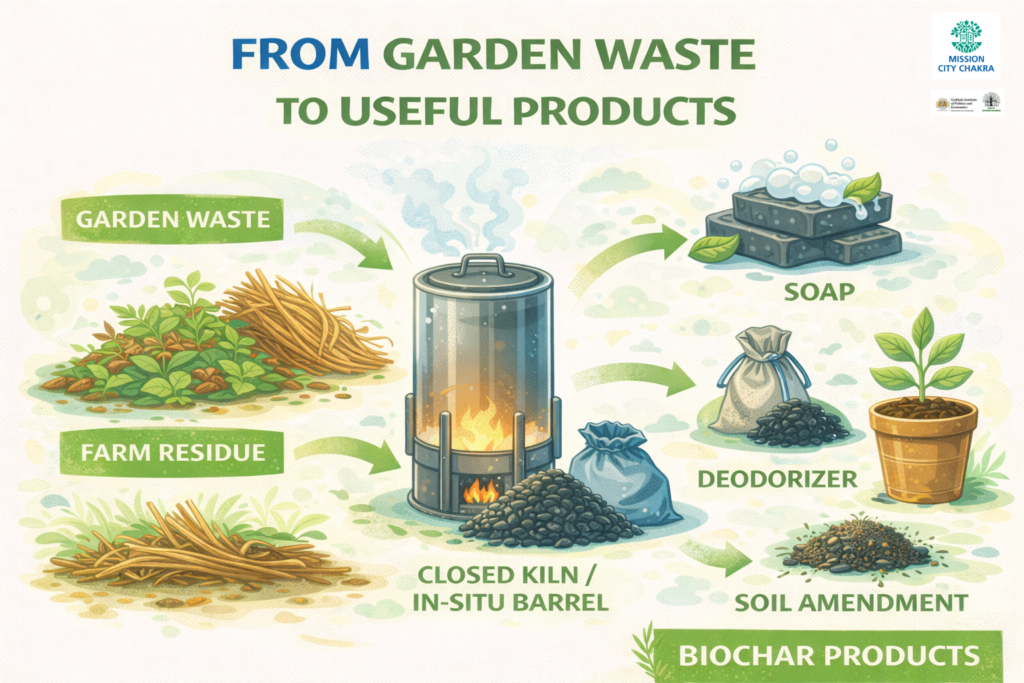
Biochar products such as soaps, deodorizers, and soil enhancers convert garden and farm waste into valuable materials. Learn how biochar prevents open burning, reduces pollution, improves soil health, and opens new entrepreneurial opportunities.
What if garden waste didn’t need to be burned at all?
Across cities and farms, plant waste is often seen as a problem:
dry leaves from societies
branches from pruning
crop residues and stubble
weeds and twigs
When this waste is burned in the open, it leads to:
choking smog
particulate pollution
greenhouse gas emissions
loss of soil carbon
But there is another path.
That same waste can be converted into biochar — a carbon-rich material created by heating biomass in a low-oxygen kiln. Instead of releasing carbon into the air, biochar locks it in solid form for decades or even centuries.
And from biochar, a whole range of products can be created.
Biochar products are a perfect example of reducing waste and emissions by design, not by guilt.
What is biochar?
Biochar is produced by pyrolysis — controlled burning in the absence of oxygen.
The result is:
porous
black
carbon-rich
highly adsorptive
microbe friendly
Biochar behaves like activated carbon from plants and can be used in:
soils
personal care products
filters
deodorizing applications
Everyday products that can be made from biochar
Here are some key categories of biochar-based products already emerging.
1️⃣ Biochar soap
Biochar powder can be added into natural soaps.
Benefits:
deep cleansing
oil adsorption
deodorizing effect
anti-tan reputation
gentle exfoliation
Design advantage:
links personal care to climate action
great educational product
premium gifting potential
2️⃣ Biochar deodorizer pouches
Biochar absorbs odors and moisture because of its porous structure.
These small fabric pouches can be kept in:
cupboards
shoes
refrigerator
cars
bathrooms
pet areas
They act as:
deodorizer
mild dehumidifier
toxin adsorber
Unlike chemical fresheners, they do not mask odor — they actually absorb it.
3️⃣ Biochar for soil improvement
This is the largest environmental impact use.
Biochar added to soil helps:
retain water
hold nutrients
support beneficial microbes
improve soil structure
reduce fertiliser loss
And importantly —
Biochar stores carbon underground rather than in the atmosphere.
A single kilo of properly prepared biochar represents carbon that did not become CO₂ and PM during open burning.
Environmental impact of biochar products
✔ Prevents open burning of garden/farm waste
If leaf litter, pruned branches, or straw is burned:
carbon becomes CO₂
particulates become PM2.5/PM10
smoke affects lungs, hearts, and visibility
When converted to biochar:
carbon stays locked
smoke & pollution is avoided
climate benefits accumulate
✔ Carbon sequestration / climate neutrality
Biochar is one of the world’s most recognised carbon-removal pathways.
Creating biochar:
converts unstable carbon → stable carbon
prevents methane from anaerobic decomposition
stores carbon in soil for long periods
Therefore biochar products can honestly be positioned as:
climate-positive or carbon-sequestering products
(not just “less bad” — actually beneficial)
✔ Prevents synthetic ingredient dependence
Biochar replaces:
synthetic microbeads in scrubs
fragrance chemicals for deodorizers
plastic soil conditioners
This reduces chemical exposure and plastic leakage.
❤️ Health impacts
Biochar products contribute to health by:
reducing open burning smog exposure
avoiding harmful aerosol “air fresheners”
providing natural cleansing alternatives
improving indoor air quality
supporting safer soil for growing food
The biggest health gain is clean air when waste is not burned openly.
Business & entrepreneurial potential
Biochar product entrepreneurship sits at the intersection of:
climate innovation
waste management
personal care
urban ecology
agriculture
A startup can:
collect garden waste from societies or municipalities
produce biochar using mobile or fixed kilns
convert biochar into value-added products
sell locally with strong storytelling
Why this excites entrepreneurs:
low raw material cost (waste → resource)
strong narrative appeal
premium eco-product market
carbon credit potential in future
partnerships with schools, ecoclubs, cities
This is particularly powerful for:
youth innovators
women’s SHGs
farmer producer companies
climate entrepreneurs
Sustainability rating matrix
| Criterion | Rating (5⭐) | Reason |
|---|---|---|
| Waste reduction | ⭐⭐⭐⭐⭐ | Prevents open burning |
| Climate benefit | ⭐⭐⭐⭐⭐ | Carbon sequestration |
| Health benefit | ⭐⭐⭐⭐ | Less smoke, fewer chemicals |
| Market demand | ⭐⭐⭐⭐ | Growing eco-product segment |
| Startup feasibility | ⭐⭐⭐⭐ | Low input cost, high story value |
| Scalability | ⭐⭐⭐ | Needs logistics & kilns |
| Innovation appeal | ⭐⭐⭐⭐⭐ | Links waste → climate → product |
🧭 Final thought
Biochar products show us something profound:
Smoke does not have to enter the sky.
It can become soap in your bathroom,
a deodorizer in your cupboard,
or richness in your soil.
They are:
climate-positive
health-supporting
entrepreneur-friendly
rooted in local waste streams
They are truly products that reduce waste by design, not by guilt.