
This is an information snippet about the materials, their recyclability, impact about the Flexible, plastic spout pouches, in India, commonly known as ‘Pichku Pouches‘ referring to the action of squeezing the content out.
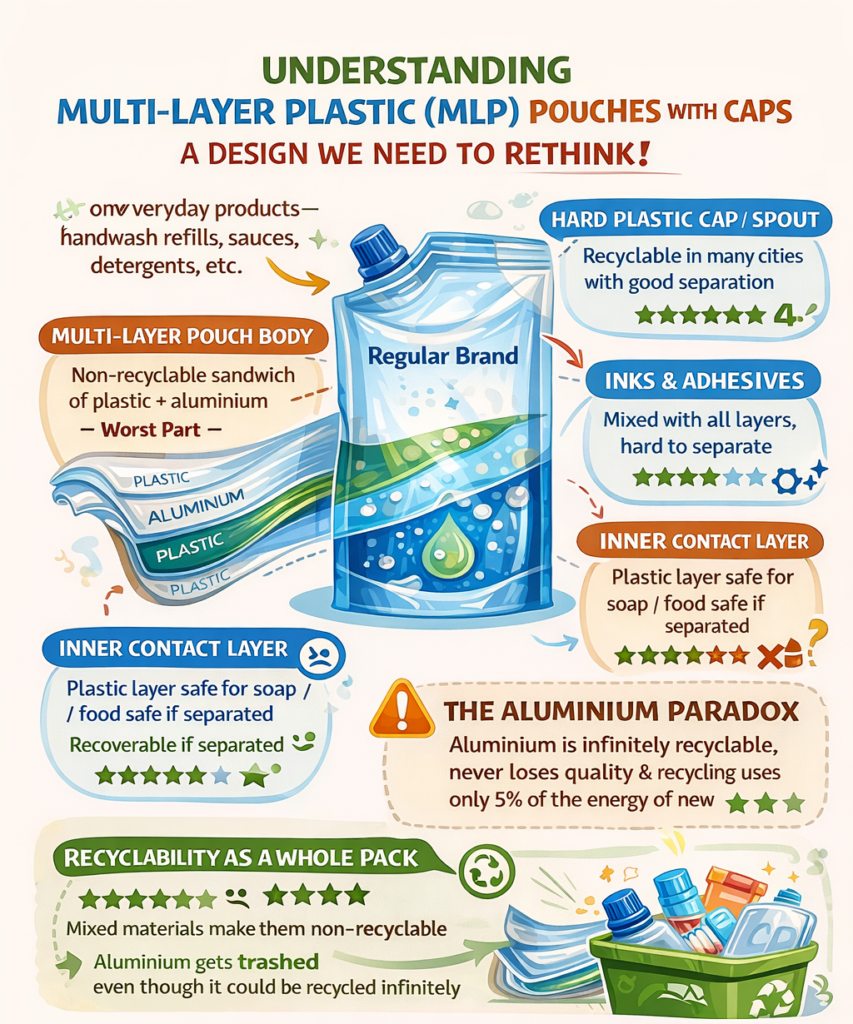
Multi-Layer Plastic (MLP) Pouches with Caps — A Design We Need to Rethink
Many everyday products—handwash refills, sauces, detergents, shampoo, mayo—come in flexible refill packs. These usually have:
a soft pouch body
a rigid spout or cap
printed branding layer
sometimes an inner barrier layer
While they are marketed as “refills” that save plastic, the material reality is more complex.
They often use MLP (multi-layer plastic) with small rigid plastic components. Understanding the system helps us evaluate:
what is reusable
what is recyclable
what is permanently lost to dump yards or co-processing
what better design alternatives could look like
🧩 Breaking the Pack into Components
| Component | Typical Materials | Why it is used | Recycling Potential |
|---|---|---|---|
| Outer pouch film | Multi-layer plastic (plastic + aluminium + plastic) | Strength, tear resistance, printability | ❌ Very low |
| Barrier layer | Aluminium foil or metallised plastic | Moisture & oxygen barrier | ❌ Non-recoverable in MLP |
| Inner contact layer | LDPE / PP | Food or soap contact safety | ⚠️ Recoverable only if separated |
| Spout / cap | HDPE / PP (rigid plastic) | Reusability, sealing | ♻️ Recyclable where streams exist |
| Inks & adhesives | Polyurethane, solvents | Branding, lamination | ❌ Not recyclable |
🧪 What exactly is MLP?
Multi-layer plastic (MLP) is a sandwich of many materials:
Plastic (outer)
Aluminium or metallised film (middle)
Plastic (inner)
They are bonded using strong adhesives so they behave as one tough film.
Why manufacturers like MLP
protects flavour, fragrance, moisture content
increases shelf-life
lightweight
cheaper than rigid packaging
printable for branding
puncture and leak resistant
Why waste managers dislike MLP
Because the layers cannot be separated economically.
MLP is technically complex and economically unattractive to recycle.
So even when collected, most of it is burnt, co-processed or landfilled.
🥇 The Aluminium Paradox
✔ Aluminium is infinitely recyclable
✔ It does not lose quality on recycling
✔ Almost all aluminium ever produced is still circulating
✔ Recycling aluminium uses only ~5% of the energy needed for new aluminium
BUT in MLP film:
aluminium is bonded to plastic
separation is energy-intensive and uneconomical
so it is not recycled
it goes to dumpyards, incinerators or cement kilns
So we are:
using an infinitely recyclable, high-value metal
inside
a non-recyclable composite packet
This is one of the starkest examples of design wastefulness.
A material that could stay in circulation forever is instead lost permanently.
♻️ Recycling Potential by Component
1. Rigid cap / spout
Material: HDPE or PP
recyclable in most cities if segregated
has established markets
higher density, easy to capture mechanically
👉 Best part of the pack from a recyclability perspective
2. Flexible MLP pouch body
Material: Plastic + aluminium + adhesive
cannot be mechanically recycled easily
pyrolysis exists but is energy heavy
usually sent to:
waste-to-energy
co-processing (cement kilns)
landfill
👉 Worst part of the pack environmentally
3. The full pack together
When cap and pouch remain attached:
recyclers reject the whole unit
mixed materials increase sorting cost
contamination from product residue adds burden
👉 As a whole unit, recyclability is near zero in practice.
⭐ Sustainability Rating (same structure we used earlier)
(Score out of 5 stars, where 5 = excellent)
| Criterion | Score | Comment |
|---|---|---|
| Material efficiency | ⭐⭐⭐ | Uses less plastic than rigid bottles |
| Reusability potential | ⭐⭐ | Can be refilled a few times, but rarely designed for it |
| Recyclability of rigid parts | ⭐⭐⭐⭐ | Caps and spouts are recyclable |
| Recyclability of pouch body (MLP) | ⭐ | Technically possible, rarely done |
| Overall recyclability of whole pack | ⭐ | Mixed materials kill recyclability |
| Resource respect (aluminium use) | ⭐ | High-value aluminium is lost |
| Waste leakage risk | ⭐⭐ | Light, easily littered |
| System-level circularity | ⭐ | Downcycling or destruction, not true recycling |
🔚 Overall sustainability rating for MLP pouch with cap
⭐⭐ out of ⭐⭐⭐⭐⭐
✔ better than rigid single-use bottles
❌ far worse than mono-material or powder packaging
🧭 Where this packaging does make sense
where no other barrier system works
remote supply chains with high transport cost
short-term transition from rigid to lighter packaging
emergency relief logistics
🚫 Where we should rapidly move away from it
where powders or concentrates are feasible
where reuse / refill systems exist
where mono-material packaging is possible
for products that do not need high barrier protection
🌱 Better design directions
powder formats (like your Godrej Magic example)
tablet concentrates
mono-material PE or PP films
returnable bulk dispensing
reuse systems
refill stations instead of packets
clearly labeled design-for-disassembly caps