
Why a Product’s Afterlife Is Decided at the Design Table
A reflective, collaborative blog for product designers on how end-of-life outcomes are decided during the design phase—and why refusing unnecessary elements, avoiding mixed materials, and adopting supportive sustainability frameworks is the need of the hour.
Introduction: Designers Shape Futures—Often Invisibly
Every product tells two stories.
The first is the one designers are trained to tell:
usability,
aesthetics,
cost,
market fit.
The second story begins much later:
when the product breaks,
when packaging is discarded,
when materials enter waste streams.
What we often forget is this:
The second story is largely written during the first.
A product’s end of life—whether it is reused, recycled, downcycled, or dumped—is not decided at the bin.
It is decided at the design table.
End of Life Is Not an Afterthought—It Is a Design Outcome
Once a product is launched, most downstream actors—consumers, waste workers, municipalities—have limited agency.
They can only work with:
the materials chosen,
the complexity introduced,
the separability (or lack of it),
the mass and value embedded.
If a product:
uses mixed materials,
contains unnecessary components,
lacks standardisation,
then no amount of consumer awareness can compensate for that.
This is not a moral failure.
It is a system design reality.
Mixed Materials: When Design Elegance Becomes System Failure
From a product perspective, mixed materials often make sense:
better performance,
lighter weight,
cost optimisation,
premium look and feel.
From a waste system perspective, mixed materials often mean:
poor collectability,
no economic value for recyclers,
contamination of recycling streams,
guaranteed landfill or incineration.
Multi-layer packaging, bonded materials, composites, laminates—
these are not inherently “bad” ideas.
But without a recovery pathway that exists in the real world, they become designed dead-ends.
A product is only as recyclable as the least separable bond in its design.
The Cost of “Small, Unnecessary” Elements
Consider something as seemingly trivial as a plastic hanger inside a clothing package.
From a design or retail standpoint, it may:
improve shelf presentation,
help standardise packaging,
appear negligible in cost.
But system-wide, it means:
additional virgin material extraction,
an item with low reuse value,
poor recyclability due to size and material quality,
an extra disposal decision for the consumer.
The consumer did not ask for it.
The waste system cannot handle it efficiently.
And yet, resources were extracted, processed, transported, and discarded for it.
This is not about a hanger.
It is about a pattern.
The Burden We Quietly Shift to Consumers
When unnecessary or unrecoverable elements are designed into products, the burden shifts downstream:
Consumers are asked to “dispose responsibly”
Municipalities are expected to manage complexity
Waste workers deal with contamination and low-value streams
This creates frustration on all sides.
Designers did not intend this outcome—but the outcome still exists.
Which brings us to an uncomfortable but necessary insight:
Good intentions do not neutralise poor system compatibility.
Why REFUSE Is the Most Powerful Design Principle
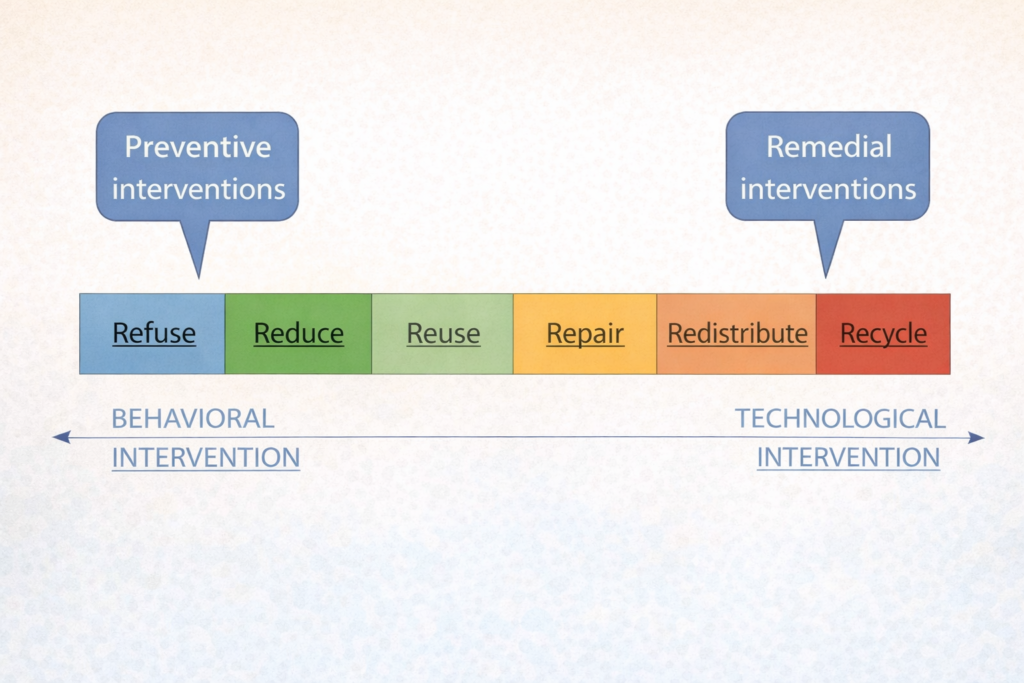
In waste hierarchies, Refuse sits at the top—but is rarely discussed in design rooms.
Refuse does not mean rejecting entire products.
It means refusing:
unnecessary components,
decorative disposables,
features added “just because they always were.”
Practising Refuse at the design stage:
saves material before extraction,
reduces manufacturing energy,
simplifies recovery,
lowers system costs downstream.
Every element that never enters the system is:
the most recyclable,
the most carbon-efficient,
the most health-safe.
Designers Cannot Do This Alone—and They Shouldn’t Have To
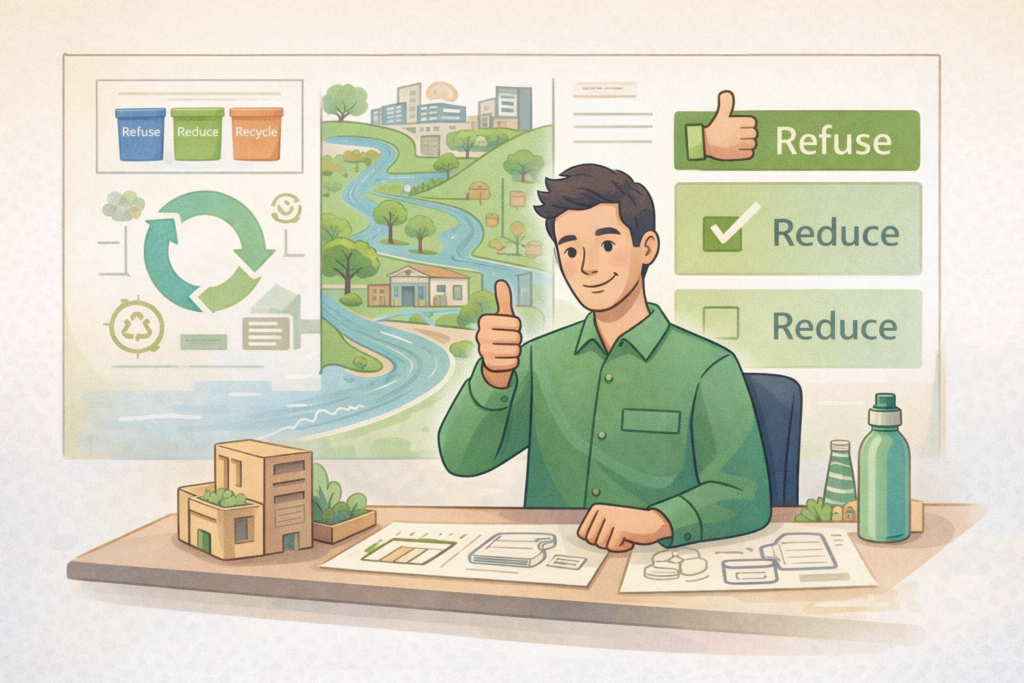
It is important to say this clearly:
This is not about pointing fingers at designers.
Designers operate within:
business constraints,
cost pressures,
supply chain realities,
brief limitations.
What is missing is not intent—but supportive frameworks.
Frameworks that:
make sustainability decisions easier, not harder,
provide clear guardrails instead of vague goals,
align design choices with real-world recovery systems,
legitimise saying “no” to unnecessary elements.
The Need for a Designer-Centric Sustainability Framework
What many designers need is:
a shared language around end-of-life outcomes,
practical design-time checklists,
clarity on what not to design,
institutional backing for upstream decisions.
A framework that asks, early and clearly:
Does this element need to exist?
Can this material be separated at scale?
Does this design simplify or complicate recovery?
Are we designing value—or just volume?
Such frameworks do not limit creativity.
They redirect it toward longevity, simplicity, and responsibility.
An Invitation, Not an Accusation
This moment is not about blame.
It is about recognising that:
designers shape defaults,
defaults shape behaviour,
behaviour shapes environmental outcomes.
And that means designers also hold extraordinary power.
The choices we make today quietly shape the world our children will inherit.
If we acknowledge that together—
and build tools, frameworks, and conversations that support better choices—
then sustainability stops being a burden and starts becoming good design.
Conclusion: Designing With the End in Mind
A sustainable future will not be built by perfect consumers.
It will be built by thoughtful systems.
And those systems begin with design.
Not at the landfill.
Not at the recycling plant.
But at the first sketch.
Closing Thought
Design is where prevention is cheapest, easiest, and most humane.
If you’re a designer, you’re not the problem.
You’re one of the most important parts of the solution.
Let’s design that future—together.