The Daily Tea-Coffee Habit We Never Question
In most offices, tea and coffee arrive in paper cups—quietly, efficiently, and without debate.
One cup.
Then another.
Every day.
It feels harmless. But let’s pause and do the maths.
The Maths of a “Small” Habit
Let’s take one office employee — Mr. X.
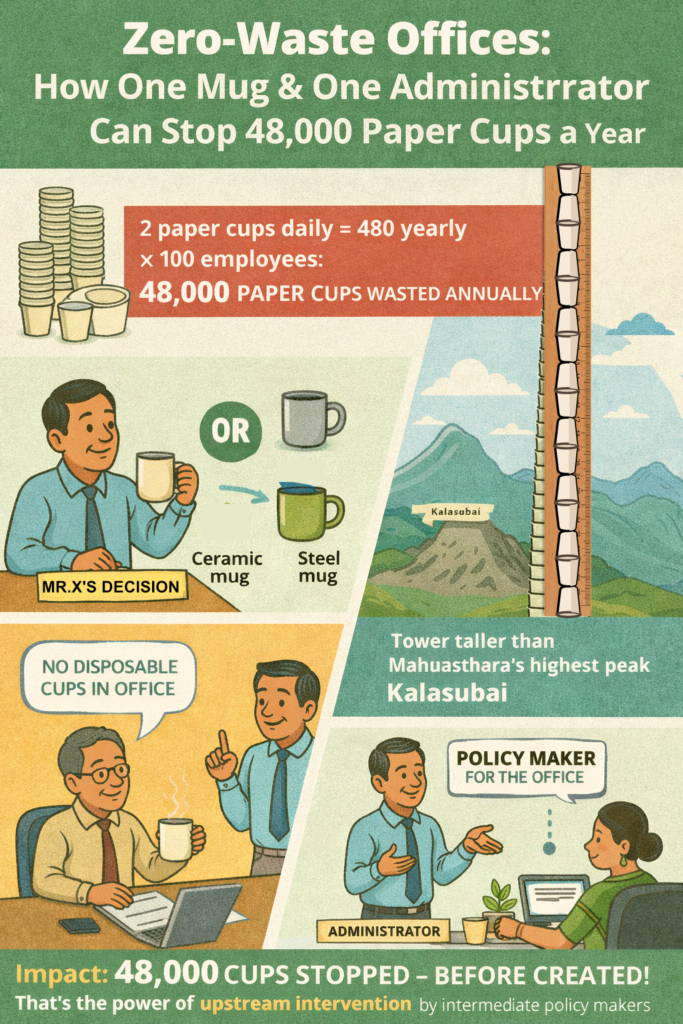
Daily: 2 paper cups
Weekly: 10 paper cups
Monthly: 20 paper cups
Yearly: ~480 paper cups
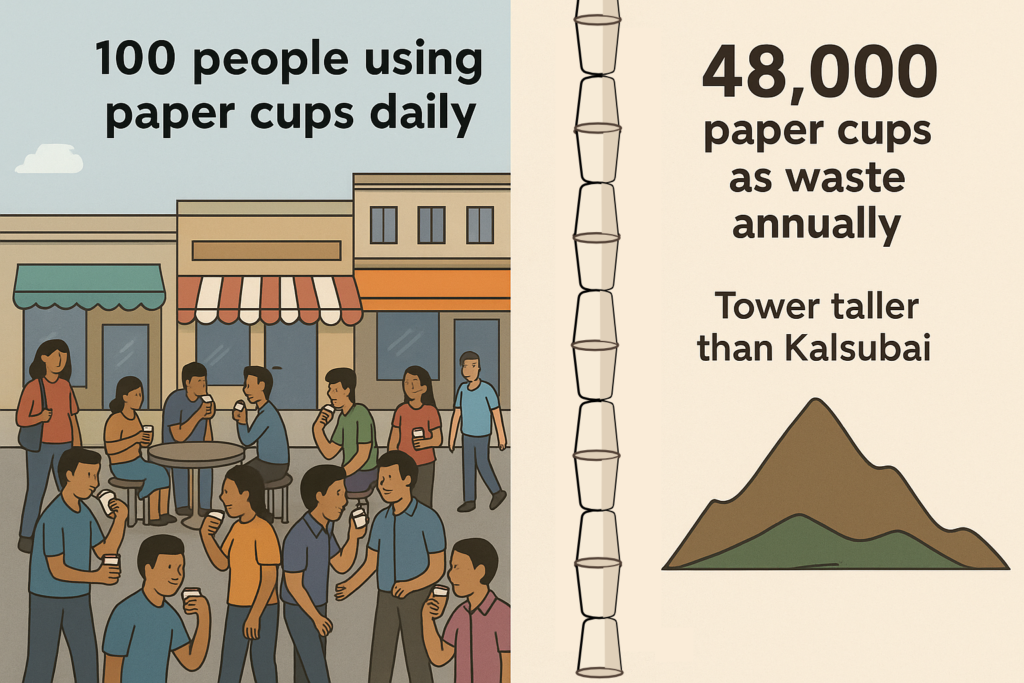
Now multiply that by an office of 100 employees:
👉 48,000 paper cups every year
And this doesn’t include:
Plastic-lined interiors of the cups
Garbage bags used to collect them
Transport, segregation, and disposal effort
All for a drink that lasts five minutes.
A Tower Taller Than the Tallest Peak in Maharashtra
If you stack 48,000 paper cups one on top of another, the height of that tower crosses Mount Kalsubai—
the tallest peak in the Sahyadri range of Maharashtra.
A mountain of waste created not by factories, not by cities—
but by a daily office routine.
One Mug Can Stop It. Immediately.
Now here’s the powerful part.
Mr. X can stop his own 480 cups instantly by doing just one thing:
-Keeping a ceramic mug or steel cup on his desk
-Reusing it every day
No technology.
No budget.
No permission required.
But what if Mr. X wants to stop the waste for the entire office?
The Policymaker Is Just a Few Feet Away
To create impact at scale, Mr. X doesn’t need to:
Go to Delhi
Write to a ministry
Wait for a national policy
The policymaker for his office is the office administrator—
sitting just a few desks away.
That’s the power of an intermediate policymaker.
If the administrator decides:
“No disposable cups in office”
“Employees bring or are given reusable mugs”
Then 48,000 paper cups disappear instantly—
before they are even created.
This Is What Upstream Intervention Looks Like
Most waste systems focus on:
Collection
Segregation
Processing
Mission City Chakra asks a different question:
Why manage waste that doesn’t need to exist?
Stopping paper cups at the office level is an upstream intervention—
turning off the tap instead of mopping the floor.
It is:
Faster than downstream solutions
Cheaper than waste processing
Cleaner than any clean-up drive
Zero-Waste Offices Are Policy Decisions, Not Behaviour Campaigns
Posters asking people to “use less” rarely work for long.
But policy decisions do.
When an administrator decides:
Reusable mugs are the default
Disposable cups are eliminated
Sustainable behaviour becomes automatic.
No reminders.
No enforcement.
No guilt.
Mission City Chakra: Scaling Change Through Intermediate Policymakers
At Mission City Chakra, we focus on intermediate policymakers—
principals, administrators, ward officers, and institutional leaders—
because they are:
✔ Accessible
✔ Quick to act
✔ Capable of immediate scale
A single decision can prevent thousands of tonnes of waste over time.