
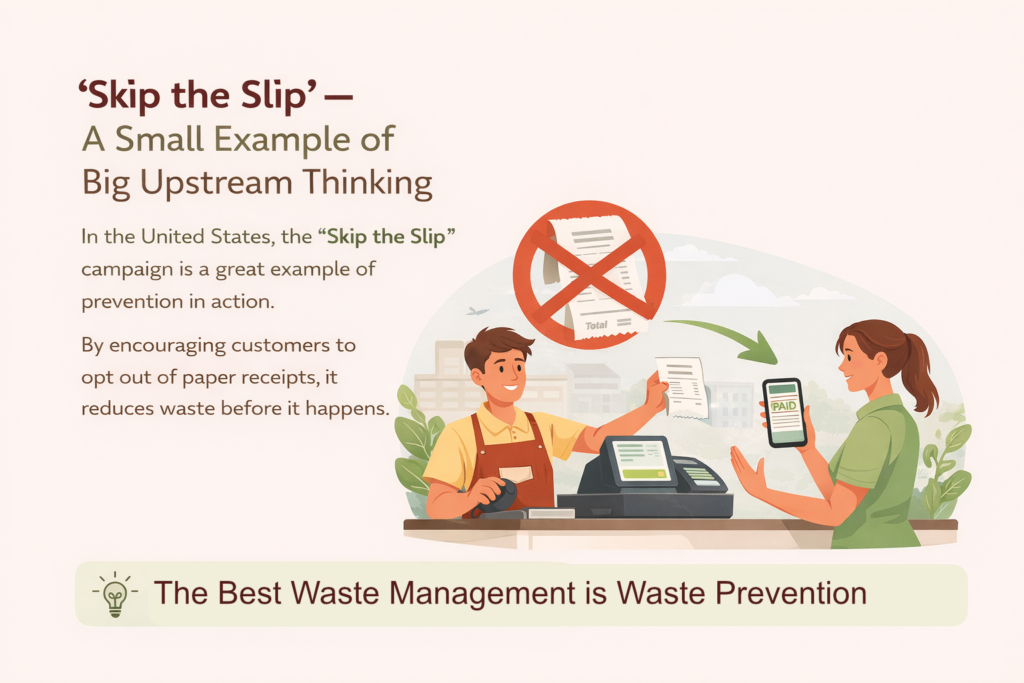
Discover the Skip the Slip movement in the US, why thermal paper receipts are harmful, and how opting out can reduce waste and protect health.
Every day across the world, millions of shoppers receive paper receipts they quickly discard, tuck into pockets, or forget at the bottom of their bags. What feels like a small slip of paper has huge environmental and health implications, and the Skip the Slip movement has been raising awareness and driving action around this often-ignored problem. Green America+1
What Is the Skip the Slip Movement?
Skip the Slip is a campaign led by Green America, one of the oldest nonprofit economic advocacy organizations in the United States. It highlights the widespread environmental harm and health risks associated with paper receipts — especially those printed on thermal paper — and advocates for alternatives such as digital receipts or opting out of unnecessary printing. Green America
The campaign’s short-term goal has been to reduce wasteful and toxic paper receipts, while its broader aim is to raise public and corporate awareness about the unseen costs of everyday materials we take for granted. Green America
Why Receipts Are a Bigger Issue Than You Think
Thermal Paper and Chemicals
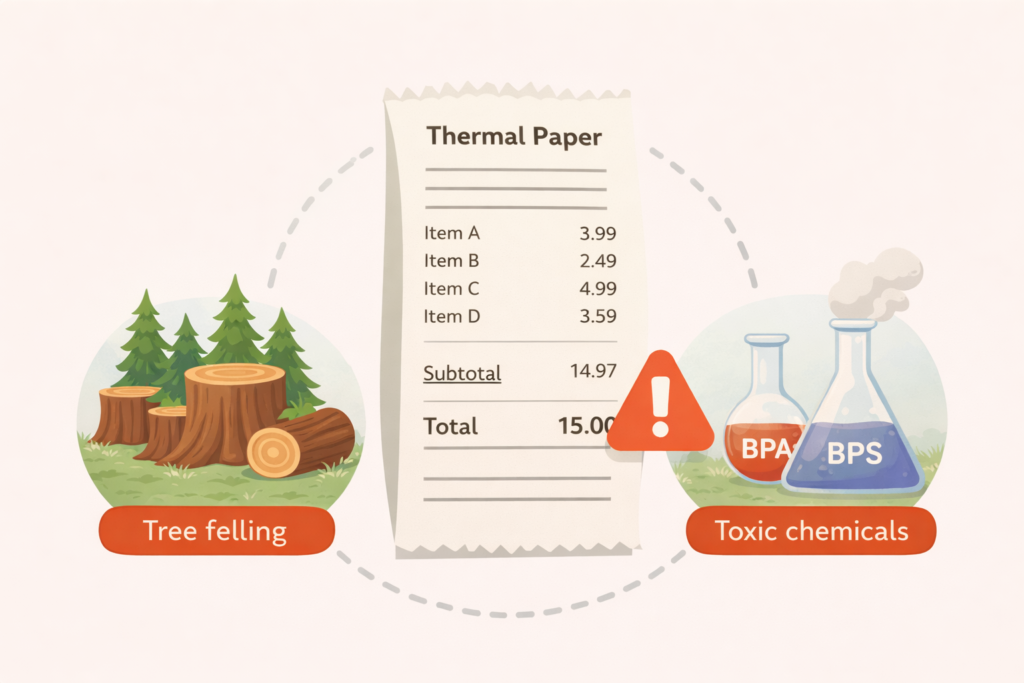
Most paper receipts in retail environments are printed on what is called thermal paper — a special material that changes colour when heated, allowing printers to produce receipts without ink. Wikipedia
To make the printing work, thermal paper is coated with chemicals such as Bisphenol A (BPA) or its analog Bisphenol S (BPS). These substances are used because they react with heat to reveal text and images, but they are also endocrine-disrupting chemicals that can be absorbed through skin contact. Green America
The presence of these chemicals has raised health concerns, especially for retail workers who handle receipts repeatedly, and for consumers who may touch them daily. Green America
Environmental Impact of Paper Receipts
Although they are small, paper receipts collectively have a large environmental footprint:
Trees and water use: Annual receipt production in the U.S. consumes millions of trees and billions of gallons of water. Green America
Greenhouse gases and waste: The process of producing and disposing of receipt paper contributes billions of pounds of carbon dioxide and solid waste to the environment. Green America
Resource inefficiency: Most receipts are discarded or lost shortly after issuance, meaning the resources used to produce them are wasted almost immediately. Green America
Because thermal paper receipts often cannot be recycled due to chemical coatings, they complicate waste management systems and can contaminate recycled paper streams even when people try to recycle them. Wikipedia
How Skip the Slip Started and What It Has Achieved
The Skip the Slip campaign began in the late 2010s as an effort to challenge default receipt printing practices and push for more sustainable alternatives. The campaign has used research reports, consumer outreach, and partnerships with retailers to drive change. Green America
Corporate Engagements and Progress
One of the biggest outcomes of the Skip the Slip campaign has been engagement with large retailers. For example:
CVS Pharmacy, one of the largest retail chains in the U.S., introduced prompts at checkout that let customers choose between printed, digital, or no receipt options. In less than a year, this change saved tens of millions of yards of paper. Business Wire
CVS also moved to phenol-free paper across its stores and reduced printed circulars in many markets, cutting overall paper use significantly. Business Wire
Other companies, such as Apple, Best Buy, and Ben & Jerry’s, have received higher marks in Skip the Slip scorecards for offering more sustainable receipt options, while many retailers still lag behind and rely on traditional thermal paper receipts. Green America
Legal and Policy Interest
The campaign has also influenced legislative efforts. In California, a bill inspired by Skip the Slip proposed requiring businesses to offer electronic receipts by default, with paper copies only on request. Although this specific bill did not pass the full legislature, it indicates a growing policy interest in rethinking receipt waste. CNBC
Consumer Attitudes and Behaviour
Consumer surveys show that a large majority of Americans would prefer digital options:
Around 86 percent of respondents said retailers should offer digital receipts. Business Wire
Many people already throw away or lose almost half of the paper receipts they receive, demonstrating a mismatch between issuance and actual need. Green America
This suggests that eliminating default printed receipts — or offering them only by customer request — is not only environmentally sensible but also aligned with customer preferences. Green America
What Comes Next
The Skip the Slip movement highlights a broader truth in environmental action: small objects can have big impacts. By rethinking everyday items like receipts, we can reduce waste at the source — preventing harm rather than managing it after the fact.
Retailers, policymakers, and consumers all have roles to play in reducing reliance on unnecessary paper receipts. Available technologies make digital and opt-in options feasible, and early corporate changes demonstrate that progress is possible.
Conclusion: Why This Matters
Skip the Slip is not just about saving paper — it’s about reframing how we think about waste and embedding prevention into everyday systems. As more businesses and communities recognise the environmental and health costs of default receipt printing, we may see a shift toward more sustainable transaction practices — one skip at a time. Green America