
Discover in this blog by Aditi Deodhar, why Mission City Chakra is urging food-delivery apps like Swiggy & Zomato to add a “No Sachets & Napkins” toggle. Learn how this simple feature can massively reduce plastic waste, save costs, and support India’s zero-waste goals.
When you order food at home, do you really need ketchup sachets, vinegar pouches, oregano packets, or paper napkins?
For most people, the answer is no—because the moment the delivery arrives, these items go straight into the trash unopened.
Yet across India, millions of condiment sachets and paper napkins are pushed into every order by default—even when consumers don’t want them. This is unnecessary waste, unnecessary cost, and unnecessary environmental harm.
At Mission City Chakra, we are working toward a Zero-Waste Pune City, and one of our simplest, high-impact policy recommendations is this:
Add a Toggle for “No Sachets & No Napkins” on Food-Delivery Apps
Just like the existing “No Cutlery” toggle introduced by Zomato and Swiggy.
And equally important!
Make This Toggle Mandatory for All Food-Delivery Platforms Through Regulation
So that even future apps automatically follow this norm.
This is low-hanging fruit. It is easy for apps to implement, easy for restaurants to comply with, and extremely powerful in reducing waste at scale.
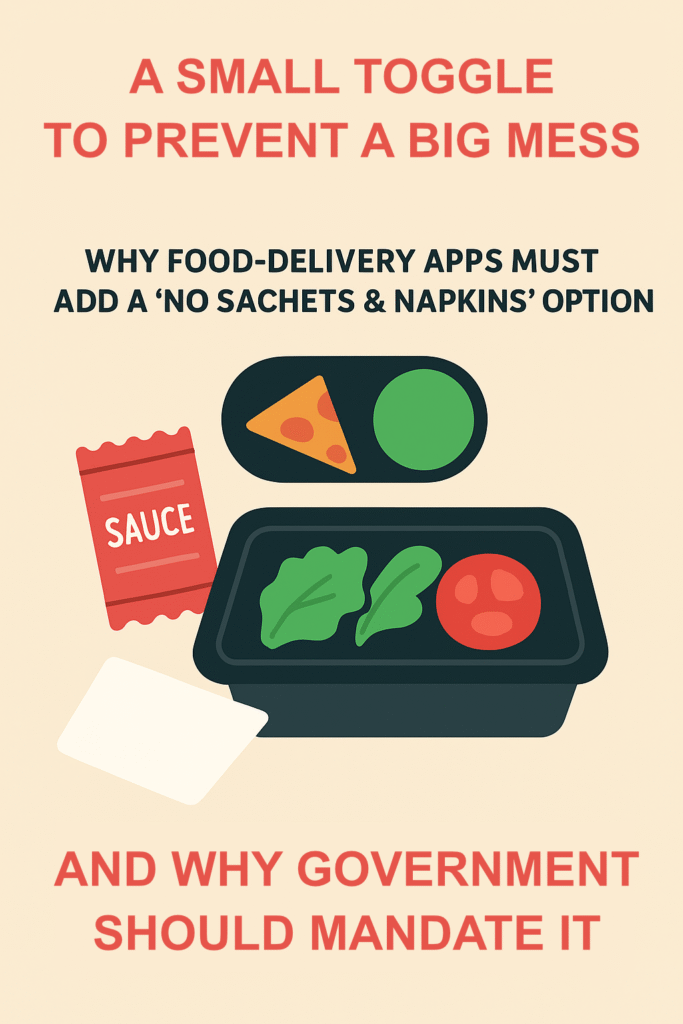
Why Sachets & Napkins Are a Hidden Waste Catastrophe
Sachets = pure single-use plastic
Ketchup, mayonnaise, vinegar, chili flakes, oregano, mouth freshener, sanitizer gel…
These tiny packets are made of multi-layered plastic, which cannot be recycled and ends up in landfills, oceans, or city drains.
Napkins = unnecessary paper burden
Most homes already have tissue rolls or cloth napkins.
Adding single-use napkins in every order wastes trees, water, and energy.
They are rarely used
Studies from waste audits (including our own observations) show that 80–90% of sachets remain unopened when food is meant for home consumption.
They are expensive to producers
Restaurants spend money on these add-ons—even though consumers never asked for them.
They encourage a mindset of excess
The easiest waste to manage is the waste we never create.
“Refuse” & “Reduce”: The First Pillars of Zero-Waste Behaviour
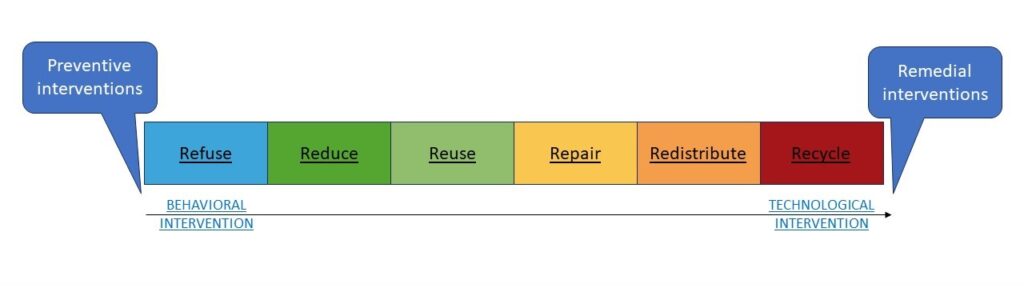
The global zero-waste hierarchy begins with:
1. Refuse
Say no to unnecessary items.
2. Reduce
Reduce consumption by eliminating default waste.
A sachet toggle is not just a technical feature—it is a behavioural nudge that helps millions of citizens follow these simple principles without any extra effort.
Why a Toggle Works: Behavioural Science in Action
Food-delivery apps already gave us a powerful example:
The “No Cutlery” Toggle
This tiny switch alone prevented hundreds of millions of forks, spoons, knives, and tissues from being sent to customers who didn’t need them.
This success happened because:
- The toggle aligned with users’ actual behaviour
- It saved restaurants money
- It caused no friction in ordering
- The default became sustainable without imposing on anyone
The same behavioural mechanism will work for sachets and napkins.
Precedents: When 'Intermediate Policy Makers' Reduced Waste with Simple Nudges
Government is the ultimate policy maker, however, policy makers exist at various levels in the society. These are the examples of how these ‘Intermediate Policy Makers’ took action without waiting for the government policies.
Zomato & Swiggy – No cutlery by default
A major success in reducing plastic waste across India.
Hotels removing toiletry miniatures
Replaced by refillable dispensers due to policy and consumer demand.
Global bans on plastic straws
Often driven by businesses adopting “ask only if needed” policies.
Starbucks & others – “Straw on Request”
Simple toggles dramatically reduced unnecessary consumption.
The sachet toggle fits neatly into these global patterns of micro-interventions with macro impact.
The Actual Impact: Why This Matters So Much
A sachet may weigh only a gram, but India processes tens of millions of food-delivery orders every day.
If even 20% of those orders opt out of unnecessary sachets and napkins, the yearly impact would be:
✔ Billions of sachets avoided
Equivalent to hundreds of tonnes of non-recyclable waste.
✔ Millions of paper napkins saved
Reducing pressure on forests and paper production.
✔ Cleaner cities
Less litter around housing societies, streets, rivers, and drainage systems.
✔ Cost savings for restaurants
Each order becomes slightly more profitable.
✔ Higher customer satisfaction
A growing number of consumers prefer “no waste” orders.
This is a classic case where sustainability + economics + convenience all align.
Why Regulation Is Necessary
While apps can voluntarily implement toggles, regulation ensures universality.
By making sachet & napkin toggles mandatory:
- All food-delivery apps adopt the same standard
- It becomes part of operational compliance for tomorrow’s startups
- Waste reduction becomes systemic rather than optional
- Cities can track impact, monitor waste reduction, and set targets
This aligns with:
- Swachh Bharat Mission (SBM) goals
- Municipal zero-waste frameworks
- EPR (Extended Producer Responsibility) logic
Consumer rights to choose reduced packaging
A Small Toggle for A Cleaner City: Our Appeal
Mission City Chakra is requesting:
To Food Delivery Apps (Swiggy, Zomato, etc.):
- Add a “No Sachets & Napkins” toggle immediately
- Default it to OFF (meaning no sachets unless requested)
- Display this option prominently during order checkout
- Report annual statistics on how many sachets were saved
To Policymakers and Municipal Corporations:
- Make such toggles mandatory for all food-delivery platforms
- Integrate this into plastic reduction policies
- Encourage behavioural nudges as part of smart city design
A Future of Less Waste Starts With One Simple Choice
A No-Sachet toggle won’t solve all of India’s waste problems.
But it will solve one entire category of unnecessary waste at almost zero cost.
The most powerful policies are often the simplest—those that change behaviour quietly, steadily, and at scale.
👉 Let’s make ordering food at home cleaner
👉 Let’s help restaurants and delivery apps reduce waste
👉 Let’s give people the power to refuse what they don’t need
👉 Let’s build a smarter, cleaner, zero-waste city
Mission City Chakra invites all stakeholders—apps, restaurants, citizens, and policymakers—to adopt this small but transformative change.